

200
Protection
☪️
Islamic Crescent
Middle East
The crescent moon and star, a symbol of Islamic faith found on mosques, flags, and protective amulets across the Muslim world.
4.7Learn more →


Thirty-three or ninety-nine beads used to count the ninety-nine names of Allah and cultivate mindful devotion.
Tasbih prayer beads, also called Misbaha or Subha, are among the most personal and intimate devotional objects in Islamic practice, consisting of 33 or 99 beads used to count the repetition of divine praises. The most common formula involves repeating three phrases 33 times each after prayer — Subhan Allah (Glory be to God), Al-hamdu lillah (Praise be to God), and Allahu Akbar (God is Greatest) — for a total of 99 repetitions corresponding to the 99 names of Allah listed in Islamic tradition. This practice of dhikr (remembrance) is believed to calm the heart, purify the soul, and draw the practitioner into continuous awareness of the divine.
The beads themselves have become objects of great artisanal beauty — carved from amber, coral, sandalwood, olive wood, onyx, turquoise, and even precious gems, tasbih can range from simple wooden beads costing a few coins to elaborate amber or coral strings worth thousands of dollars. In Gulf Arab countries particularly, selecting, gifting, and displaying fine tasbih is a mark of refined taste and devotion, and the clicking sound of beads moving through the fingers is a ubiquitous acoustic backdrop of Arab social gatherings. Men in the Arab world commonly carry tasbih in their hands even when not actively praying, running beads through their fingers as a mindfulness practice.
Beyond their devotional function, tasbih are given as gifts at marriages, funerals, Hajj completions, and religious holidays. A set of prayer beads connects the holder to an unbroken chain of Islamic devotional practice stretching back to the earliest centuries of the faith.
Continuous remembrance of God, spiritual discipline, and the cultivation of a heart that remains oriented toward the divine even amid the distractions of daily life. Tasbih practice is considered one of the easiest and most rewarding acts of worship.
Hold the tasbih in the right hand with the bead between thumb and index finger, move one bead per recitation. Use after the five daily prayers for the traditional 33-33-33 formula. Keep near the bed for nighttime dhikr. Gift as a symbol of wishing someone spiritual peace and divine connection.
Some Islamic scholars trace the origin of Catholic rosary beads to the Crusaders' encounter with Islamic tasbih — the practice of counting prayers on beads moved from Islamic to Christian tradition in the 12th-13th centuries, making the tasbih a possible ancestor of one of Christianity's most recognized devotional objects.
Both are used for the same devotional practice. With a 33-bead tasbih you complete three rounds for 99 total recitations. A 99-bead tasbih completes the count in one round. The 33-bead version is more compact and common for everyday carry, while the 99-bead version is often more decorative.
While their primary purpose is devotional, many Muslims also use tasbih as a stress-relief and mindfulness tool throughout the day, regardless of formal prayer context. The rhythmic handling of beads is recognized across cultures as calming — it's essentially an ancient form of tactile meditation.
In Islamic tradition no material is inherently superior, but natural materials are preferred. Baltic amber is prized in the Arab world for its warmth, beauty, and supposed health benefits. Olive wood from Jerusalem carries spiritual weight. Coral was traditionally valued. Today synthetic materials are also common for affordable, everyday use.
Middle East
The crescent moon and star, a symbol of Islamic faith found on mosques, flags, and protective amulets across the Muslim world.
Middle East
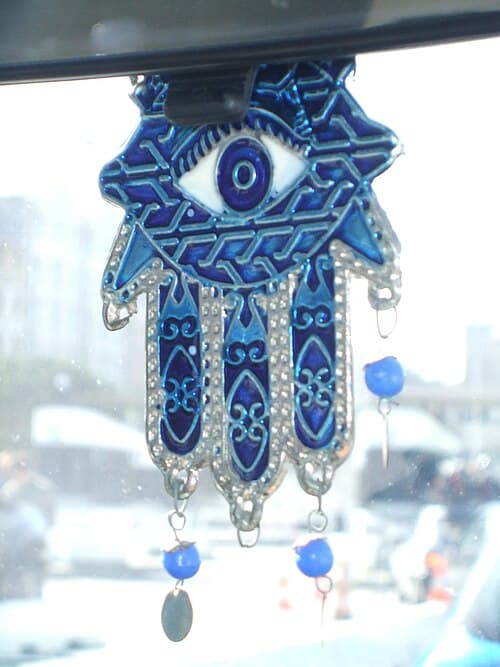
An open palm amulet warding off the evil eye across Middle Eastern and North African cultures.
Middle East / North Africa
The sacred open palm named for the Prophet Muhammad's daughter, a cornerstone of Islamic protective symbolism.

