
5
Protection
🖐️
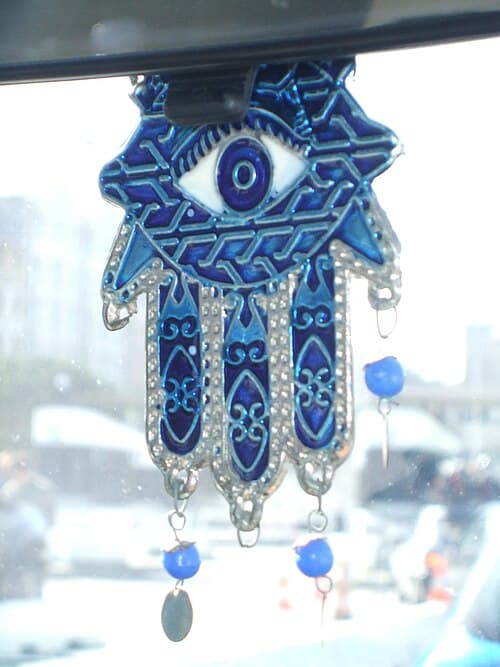
Hamsa Hand
Middle East
An open palm amulet warding off the evil eye across Middle Eastern and North African cultures.
4.9Learn more →

The sacred open palm named for the Prophet Muhammad's daughter, a cornerstone of Islamic protective symbolism.
The Hand of Fatima, called Khamsa or Khamesh in Arabic, honors Fatima al-Zahra, the beloved daughter of the Prophet Muhammad and wife of Imam Ali. She is revered in both Sunni and Shia Islam as a paragon of virtue, patience, and divine blessing. The open palm amulet named for her is believed to carry her baraka — her spiritual blessing — to all who hold or display it, forming a wall between the faithful and harm. In North Africa, the symbol is sometimes called 'the Hand of Fatima' and sometimes simply 'khamsa,' with the two terms used interchangeably.
In Moroccan culture, the Hand of Fatima is one of the most important protective symbols and appears carved into wood above doorways, hammered into brass door knockers, woven into textiles, and stamped into leather goods. Berber communities in the Atlas Mountains have incorporated the symbol into their distinctive silver jewelry for centuries, blending it with indigenous geometric patterns to create uniquely regional amulets. In Algeria and Tunisia the motif appears similarly across craft traditions.
The Hand of Fatima also carries strong associations with Fatima's earthly suffering — according to tradition she was grinding grain when she heard of her husband's planned second marriage, and her hand was burned. The open palm thus represents endurance, patience in hardship, and the hope that divine protection follows sincere faith.
Divine protection, fertility, and blessings from Allah channeled through the saintly intercession of Fatima. The five fingers remind the faithful of the Five Pillars of Islam: Shahada, Salat, Zakat, Sawm, and Hajj.
Hang above the main entrance of a home to protect the household from evil and invite divine blessing. Wear as a pendant over the heart for ongoing spiritual protection. Brides in Morocco and North Africa traditionally wear Hand of Fatima jewelry to ensure a blessed and protected marriage.
In some Moroccan Berber communities, a Hand of Fatima amulet is the first gift given to a newborn child, placed near the cradle even before the naming ceremony to ensure divine protection during the vulnerable early days of life.
While it holds specific religious significance in Islam, the Hand of Fatima as a protective amulet is used across religious lines in North Africa and the Middle East. Many Christians and Jews in the region use the same symbol under the name Hamsa or Khamsa as a shared regional protective tradition.
Five (khamsa in Arabic) is considered deeply sacred — it represents the Five Pillars of Islam, the five members of the Prophet's household (Muhammad, Fatima, Ali, Hassan, and Hussein), and the five books of Moses. The five-fingered hand thus concentrates this protective numerology into one symbol.
Moroccan versions tend to be more ornate, incorporating Berber geometric patterning, filigree silverwork, and sometimes coral or amber stones. Turkish Nazar amulets are more often the simple blue glass eye. Israeli Hamsas frequently feature Hebrew text or Star of David motifs alongside the palm.
Middle East
An open palm amulet warding off the evil eye across Middle Eastern and North African cultures.
Israel
The Jewish version of the Hamsa hand, inscribed with Hebrew prayers and the Shema to protect against the evil eye.

Morocco / Algeria / Tunisia
Ancient Amazigh cloak pin loaded with symbolic protective geometry, silver power, and tribal identity.

