
15
Protection
🕉️
Om Symbol
India
The primordial sound of the universe, Om is the most sacred symbol in Hinduism, Buddhism, and Jainism.
4.9Learn more →


One of the oldest symbols of good fortune in human history, the Hindu swastika represents the eternal cycle of prosperity and well-being.
The swastika is one of the most ancient symbols of auspiciousness known to humanity, appearing in the archaeological record across South Asia, Central Asia, and Europe for at least 11,000 years before any modern political associations were applied to it. In Hindu, Buddhist, and Jain traditions, the swastika (from the Sanskrit svastika, meaning 'conducive to well-being') represents the sun, the cycle of the seasons, the four cardinal directions, and the eternal nature of good fortune. It remains ubiquitous across Indian religious life, painted on doorways during festivals, inscribed on the first page of account books, and marked on brides' palms at weddings.
In Hindu cosmology, the swastika's four arms represent the four Vedas, the four directions, the four stages of life (ashrama), and the four aims of life (purushartha). The rotation of the arms represents the eternal movement of the cosmos around a stable center — a visual meditation on how all of life cycles while truth remains constant. The right-facing swastika (clockwise) is the most common auspicious form, associated with Vishnu and the sun. The left-facing swastika (counterclockwise) is associated with Kali and the night, used in specific tantric contexts.
Despite the profound burden placed on this symbol by its 20th-century misappropriation in Europe, the swastika continues to function as an uncomplicated sign of well-being throughout South and Southeast Asia. Understanding this ancient charm requires separating it entirely from the inverted, tilted Nazi symbol, which is geometrically and culturally distinct. Reclaiming knowledge of the swastika's original meaning is itself considered an act of cultural restoration by many scholars and practitioners.
Eternal well-being, the auspicious movement of the cosmos, prosperity in all four directions, and the sun's life-giving power.
Draw a swastika in red kumkum paste on doorways at the start of festivals, especially Diwali and Akshaya Tritiya. Mark account books and new business ledgers. In personal use, a small swastika pendant in gold is worn for general prosperity and protection.
The word swastika appears in Rudyard Kipling's original books — he used it as a personal emblem on his books' covers until World War I, when he removed it out of respect for what the symbol had come to represent in Europe.
The Hindu swastika is typically oriented with arms at right angles and sits flat on a horizontal or vertical axis. The Nazi symbol was tilted 45 degrees and used an inverted (mirrored) orientation. The cultural, historical, and geometric differences are significant.
Context is everything. In Hindu, Buddhist, or Jain religious contexts, the symbol carries its original sacred meaning. Open display in non-religious Western contexts can cause distress to people unaware of the distinction, so clear contextualization is advisable.
Diwali, Dhanteras, weddings, housewarming ceremonies (grihapravesh), the start of new business ventures, and Navratri are the most common occasions. It is also drawn whenever a new account book, vehicle, or major purchase is inaugurated.
India
The primordial sound of the universe, Om is the most sacred symbol in Hinduism, Buddhism, and Jainism.

India
Sacred floor art drawn at thresholds and courtyards to welcome Lakshmi and repel negative energies through geometric beauty.
India
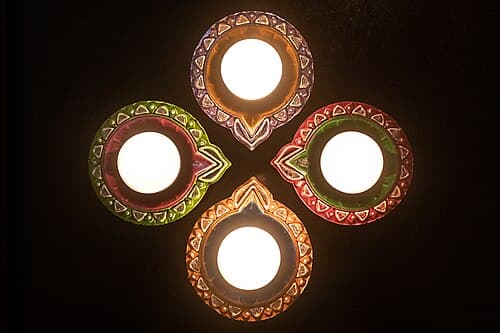
The clay oil lamp is the most fundamental symbol of the dispelling of darkness and the inviting of divine light into one's life.

India
The sacred red mark applied to the forehead activates the ajna chakra and marks the body as consecrated to the divine.

