

15
Protection
🕉️
Om Symbol
India
The primordial sound of the universe, Om is the most sacred symbol in Hinduism, Buddhism, and Jainism.
4.9Learn more →


The elephant-headed Hindu deity Ganesha is the remover of obstacles and the lord of new beginnings.
Ganesha, the beloved elephant-headed son of Shiva and Parvati, occupies a singular position in the Hindu pantheon as the deity invoked before any new undertaking. Whether one is starting a business, moving into a new home, taking an examination, or beginning a journey, Ganesha is petitioned first to clear the path of unseen obstacles. His elephant head symbolizes wisdom and the power of discriminating intellect, while his large ears are said to hear the prayers of all beings simultaneously.
The iconography of Ganesha is rich with symbolic detail that makes every figurine a portable theology. His broken tusk, which he holds in one of his four hands, was used to write the Mahabharata; it symbolizes sacrifice in the pursuit of knowledge. His large belly represents the cosmos — he contains all of creation within himself. The mouse at his feet, his vehicle, represents the ego that must be controlled and redirected. Together these symbols communicate a complete philosophy of how to navigate a world full of challenges.
Ganesha worship has spread far beyond the Indian subcontinent. In Bali, Indonesia, Ganesha statues guard temple gates in a tradition that has persisted since the 9th century. In Japan, he appears as Kangiten. In Thailand, his image is found in shopping centers and businesses. This global reach testifies to the universal appeal of his core promise: wisdom and help with practical obstacles, offered with his legendary good humor and love of sweet offerings.
Removal of obstacles, wisdom in new beginnings, intellect, prosperity, and the benevolent bridging of human aspiration with divine grace.
Place a Ganesha figurine at the entrance of a home or business facing outward. Before starting any new project, light incense before the figurine and state your intention clearly. Offer modak sweets or coconut on auspicious days. Keep the figurine clean and well-lit.
In 1995, a mass phenomenon swept India and then spread globally when statues of Ganesha appeared to drink milk offerings. Millions of people witnessed their Ganesha statues seemingly absorbing spoonfuls of milk — a phenomenon scientists later attributed to capillary action, but which believers took as a divine sign.
Ganesha facing the north (Uttarabhadra) is considered most auspicious for the home. East-facing Ganesha is ideal for temples and meditation rooms. South-facing Ganesha is generally avoided for indoor home placement in classical Vastu tradition.
A trunk curling to the left (Vamamukhi) is easier to please and suitable for household worship. A trunk curling to the right (Dakshinamukhi) is considered more powerful and demands strict ritual observance — it is more commonly found in temples than homes.
Traditional guidelines suggest keeping no more than one Ganesha idol per prayer space for focused devotion. Multiple figurines in decorative contexts throughout the home are widely practiced and not considered problematic by most traditions.
India
The primordial sound of the universe, Om is the most sacred symbol in Hinduism, Buddhism, and Jainism.

India
The sacred elephant symbolizes wisdom, prosperity, and the removal of obstacles across South and Southeast Asia.
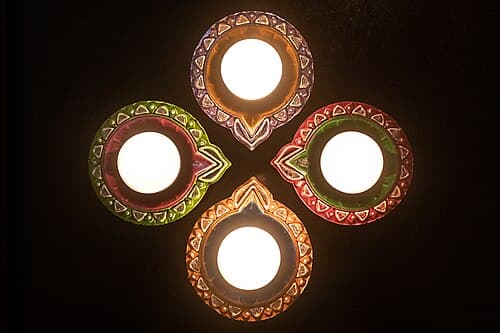
India
The clay oil lamp is the most fundamental symbol of the dispelling of darkness and the inviting of divine light into one's life.

India
The pot filled with sacred water and crowned with a coconut and mango leaves represents the universe and invites the gods to reside within.

