

80
Protection
🔴
Bindi
India
The decorative forehead dot marks the ajna chakra, protecting the wearer and concentrating intuitive power.
4.5Learn more →

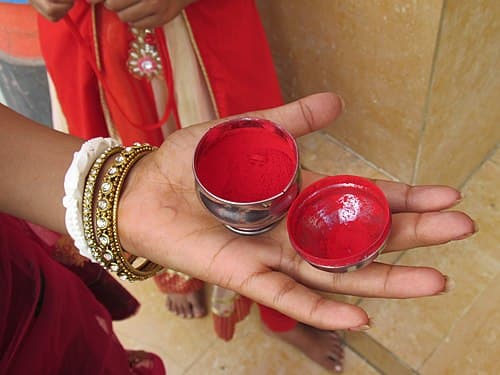
The ornate container for sindoor (vermilion) is a sacred object symbolizing marital love, a wife's protection of her husband, and the divine feminine.
The sindoor box (sindoordan or sindoor dani) is an ornate container, typically made of silver or gold, designed to hold sindoor — the red vermilion powder that a Hindu married woman applies to the parting of her hair as a mark of her marital status and her active prayer for her husband's long life and good health. The sindoor itself is considered an offering of the wife's own life force (shakti) to protect her husband, and the box that contains it takes on the sacred nature of its contents. A sindoor box is often among the most precious objects in a Hindu bride's trousseau, crafted with intricate traditional motifs.
The tradition of sindoor is among the most powerful and emotionally significant in Hindu marriage culture. The husband applies sindoor to the bride's hair parting during the wedding ceremony (sindoor daan) as a formal declaration of marriage, and from that moment the wife wears sindoor daily as long as her husband lives. The application of sindoor each morning is understood as an act of prayer and protective love — a daily renewal of the marriage vow and a petition for the husband's protection. This daily ritual has been maintained for thousands of years across millions of Hindu households, making it one of the most consistently practiced domestic religious rites in the world.
The sindoor box carries the energy of this profound daily devotion. A well-maintained sindoor box that has been used for years or decades by a devoted wife is considered to accumulate powerful positive energy — the concentrated intention of years of loving daily prayer. Such boxes are passed down through generations as family heirlooms, each generation's use amplifying the object's sacred power.
Marital love and devotion, the protective power of a wife's prayer for her husband, the continuation of the marriage bond through daily ritual renewal, and the divine feminine expressed in conjugal dedication.
Keep the sindoor box on your personal altar or dressing table in a clean, elevated position. Refill with fresh sindoor regularly — vermilion made from turmeric and lime (natural sindoor) is most auspicious. Apply sindoor each morning after prayers with the ring finger of the right hand. After a husband's death, the sindoor box is traditionally closed and never reopened.
In 2017, a major controversy arose in India when commercial sindoor products were found to contain lead and other toxic metals marketed as traditional red sindoor. This health crisis prompted a significant return to natural sindoor made from turmeric and lime — the original Vedic formulation — among health-conscious consumers, bringing the ancient practice back to its chemical origins.
In traditional Hindu observance, sindoor is strictly reserved for married women with living husbands, and removing it permanently is a painful part of the widowhood ritual. However, many contemporary Hindu scholars and practitioners reject this tradition as unnecessarily cruel, and in modern urban India especially, some widows continue to wear sindoor as a symbol of their own spiritual continuity and love.
Sindoor is specifically associated with Vaishnavism and Shaivism's domestic practices, most widespread in the Hindu heartland (North and Central India), Nepal, and among Bengali communities. South Indian Hindu married women traditionally do not wear sindoor in the hair parting — they use other symbols such as a red bindi, a specific gold necklace (thali/mangalsutra), and toe rings to indicate married status.
Silver is the most traditional and widely used material, associated with the moon and feminine energy. Gold is used for the most elaborate and valuable pieces. Conch shell sindoor boxes are used in Bengali tradition. Copper and brass are also used. The material amplifies the sindoor's protective power — silver's cooling, lunar energy is considered particularly compatible with the hot, red energy of sindoor.
India
The decorative forehead dot marks the ajna chakra, protecting the wearer and concentrating intuitive power.

India
The sacred red mark applied to the forehead activates the ajna chakra and marks the body as consecrated to the divine.

India
A string of 108 prayer beads used for mantra repetition, mala beads align the practitioner's energy with divine intention through meditative counting.
India
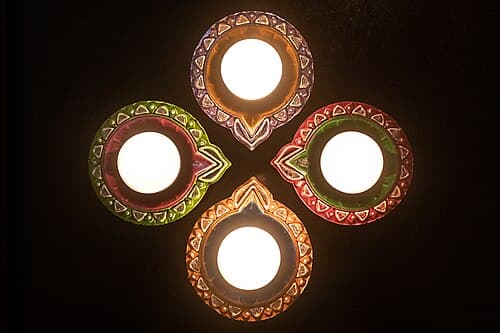
The clay oil lamp is the most fundamental symbol of the dispelling of darkness and the inviting of divine light into one's life.

