

64
General
🪷
Lotus Flower
India
Rising pure from muddy water, the lotus is the universal symbol of spiritual awakening and untouched beauty across Asia.
4.8Learn more →


The peacock feather with its all-seeing eye is associated with Lord Krishna, the goddess Saraswati, and transformative divine beauty.
The peacock feather holds a uniquely beautiful position in Indian sacred symbolism, most strongly associated with Lord Krishna, who wears a peacock feather permanently in his crown — a symbol of his playfulness, his connection to nature, and his mastery over the forces of desire (the peacock being associated with Kama, the god of love). The eye-like pattern at the feather's tip is called the 'eye of the universe,' making every peacock feather a visual representation of divine omniscience. Krishna's inseparability from the peacock feather has made it one of the most recognizable symbols of devotional Hinduism worldwide.
The peacock's annual transformation — shedding its spectacular tail feathers entirely after the monsoon season and regrowing them even more splendidly the following spring — makes it a living symbol of death and rebirth, of the shedding of the old self and the emergence of something more beautiful. This regenerative symbolism connects the peacock to both Saraswati (goddess of creativity and arts) and Karthikeya (god of war and victory), both of whom ride peacocks as their vehicles. The feather thus captures three great powers: divine knowledge (Saraswati), martial victory (Karthikeya), and divine love and playfulness (Krishna).
In practical folk use, peacock feathers are kept in the home to ward off snakes and insects (peacocks are natural predators of snakes, and the feather retains this protective energy symbolically), to bring beauty and artistic inspiration, and to invite Krishna's specifically joyful and loving form of divine blessing. A peacock feather kept between the pages of an important book blesses the knowledge within it. A feather near the writing desk invites Saraswati's grace for creative work.
Divine beauty and creative inspiration, the all-seeing eye of omniscient knowledge, protection from danger (particularly serpents), and the joyful divine love of Krishna.
Place a peacock feather in a vase on your study desk for creative inspiration. Keep a feather in books, diaries, or art supplies. Hang a feather above the main entrance of a home for protection. Do not allow peacock feathers to touch the floor. In a meditation space, a peacock feather placed near Krishna images amplifies devotional practice.
The peacock is India's national bird, chosen partly for its extraordinary beauty and partly for its mythological significance. Male peacocks perform elaborate displays to attract females — their spectacular beauty evolved entirely through the female's selection over millions of generations, making the peacock perhaps the ultimate illustration of the power of aesthetic preference to shape reality.
Yes — a peacock feather that has been naturally shed (rather than plucked) is considered especially auspicious in Hindu tradition, as it has been freely given by the peacock. Finding such a feather unexpectedly is interpreted as a blessing from Krishna or a sign of upcoming good fortune. The feather should be handled respectfully and kept in a clean place.
Some Vastu traditions caution against keeping peacock feathers in the bedroom, associating them with the god of love (Kama) in ways that may increase romantic tension or disturbance. For study rooms, living areas, and meditation spaces, peacock feathers are universally considered auspicious. The general recommendation is to avoid the bedroom if it causes any unease.
Traditional belief requires genuine peacock feathers for full talismanic efficacy. Artificial feathers can serve as visual reminders and decorative purposes, but are not considered to carry the natural energy of the real feather. The feather's power is believed to reside partly in the physical substance — the specific microstructure that creates its iridescent color is seen as evidence of divine craftsmanship embedded in the material itself.
India
Rising pure from muddy water, the lotus is the universal symbol of spiritual awakening and untouched beauty across Asia.

India
The primordial sound of the universe, Om is the most sacred symbol in Hinduism, Buddhism, and Jainism.

India
A string of 108 prayer beads used for mantra repetition, mala beads align the practitioner's energy with divine intention through meditative counting.
India
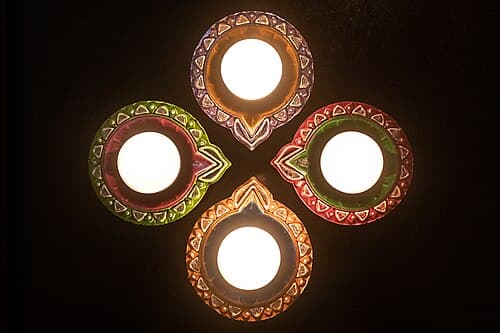
The clay oil lamp is the most fundamental symbol of the dispelling of darkness and the inviting of divine light into one's life.

