

131
Wealth
🌳
Money Tree
China
The Money Tree is a feng shui plant believed to generate positive energy and financial luck, its coin-shaped leaves symbolizing wealth growing steadily from roots of patience.
4.4Learn more →


Lucky Bamboo is a feng shui staple believed to bring good fortune, prosperity, and positive energy when placed in the home or office.
Lucky Bamboo — known in Mandarin as Fu Gui Zhu, literally 'wealthy and honorable bamboo' — has been a fixture of Chinese folk beliefs about prosperity for over four thousand years. Despite its common name, the plant (Dracaena sanderiana) is not technically bamboo at all, but a tropical water lily native to Cameroon. The confusion arose because its long green stalks closely resemble bamboo, and it shares bamboo's core symbolic virtues: flexibility, rapid growth, and the ability to thrive under adversity without losing its essential nature.
In feng shui practice, Lucky Bamboo is valued for its ability to channel and direct positive chi energy throughout a living or working space. The number of stalks in an arrangement is critically important: two stalks for love, three for happiness and long life, five for wealth, six for health, seven for health (a different emphasis), eight for growth and prosperity — eight being the luckiest number in Chinese culture because the word for eight (ba) sounds like the word for prosperity (fa). Nine stalks represent good fortune overall. The only number strictly avoided is four, as the Mandarin word for four (si) sounds identical to the word for death.
The plant's extraordinary ease of care — it thrives in plain water, requires only indirect light, and needs minimal attention — reinforces its message of effortless abundance. It is among the most popular housewarming and business-opening gifts across East and Southeast Asia, and its adoption in Western markets since the 1990s has made it one of the best-selling houseplants globally. Tying the stalks with a red ribbon activates the lucky symbolism according to feng shui principles.
Steady growth in wealth and opportunity, resilience through adversity, harmonious flow of positive energy, and lasting prosperity built on flexible strength.
Place Lucky Bamboo in the wealth corner of your home (far left corner from the main entrance, per feng shui bagua) or on your office desk. Keep it in clean water changed weekly, or plant it in well-draining soil. Tie the stalks with a red ribbon. Choose the number of stalks based on your specific intention. Avoid placing it in direct sunlight or in the bedroom according to classical feng shui.
An arrangement of 21 stalks is considered the most powerful blessing of all, combining the energy of multiple numbers — it is traditionally given as the ultimate gift for someone opening a new business or celebrating a major life milestone.
It thrives in both. Water culture (in a vase with stones and clean water) is the most common display method and is considered more feng shui-friendly because water symbolizes wealth. Soil planting produces a larger, more vigorous plant. Change the water every 7–10 days to prevent algae and bacterial growth.
Yellowing usually signals too much direct sunlight, fluoride or chlorine in tap water, or overfeeding with fertilizer. Switch to filtered or distilled water, move the plant to indirect light, and reduce fertilizer. Yellowing is not considered a bad omen — it is simply a care signal.
No — four stalks are strictly avoided as a gift in Chinese tradition because the word for four is a homophone for death. Three, six, or eight stalks are the most popular gift arrangements.
China
The Money Tree is a feng shui plant believed to generate positive energy and financial luck, its coin-shaped leaves symbolizing wealth growing steadily from roots of patience.

China
Goldfish have been symbols of wealth and abundance in China for over a thousand years, their gold color and fluid movement embodying the easy flow of prosperity.
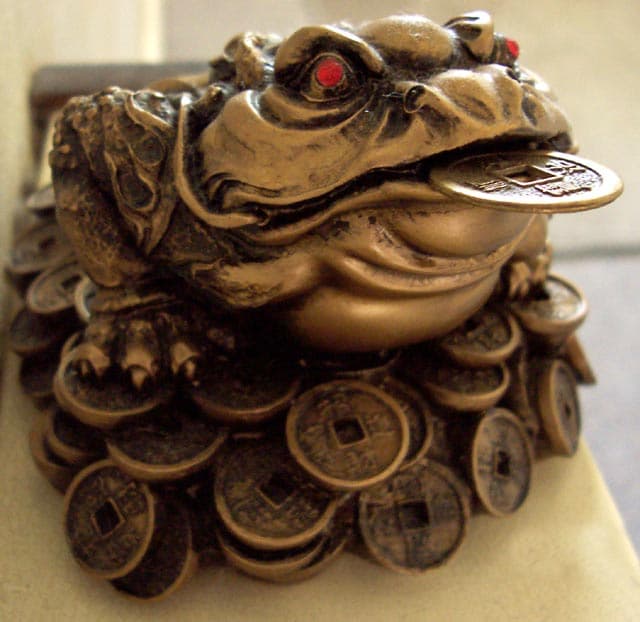
China
The three-legged toad sitting on coins with a coin in its mouth is one of feng shui's most potent wealth activators, said to attract money and prevent it from leaving.

China
The Laughing Buddha — the round, joyful, sack-carrying monk — is China's most beloved symbol of happiness, wealth, and the simple abundance that comes from contentment.

