

249
Protection
🎭
African Mask
Sub-Saharan Africa
Ceremonial mask used across Africa to embody spirits, invoke divine forces, and transform the masked dancer into a sacred intermediary.
4.7Learn more →


The powerful Poro society mask of the Dan and related peoples — used for social justice, healing, and initiation.
The 'Country Devil' masks of Liberia and Sierra Leone are the Western name given to the masks of the Poro society — the all-male initiation institution of the Dan, Kpelle, Mende, and related peoples of the West African forest zone. The Poro masks appear in specific contexts: initiating young men into adulthood, adjudicating disputes, enforcing social order, and performing healing ceremonies. The mask spirit is not understood as a human wearing a disguise but as a genuine supernatural being (the 'devil' in Krio/Sierra Leonean English meaning spirit, not the Christian devil) that temporarily inhabits the masked dancer and uses him as a vehicle for its power.
Dan masks from Liberia are among the most aesthetically refined in West Africa — smooth oval faces with slitted eyes, gently curved planes, and a tranquil beauty that belies the social power they represent. Different mask types serve different functions: small oval 'passport masks' served as personal identification in inter-village travel; large helmet masks with animal features served in the most powerful Poro ceremonies; and specially carved masks for female-associated functions were owned by the Sande society, the women's parallel initiation organization. Each mask type has its own restricted protocols, its own repertoire of powers, and its own appropriate contexts.
As objects of protective power, Poro and Dan masks represent the principle of community-sanctioned authority to enforce standards of conduct, heal the sick, and guide the young through dangerous thresholds. This is social protection as much as individual protection — the mask spirit defends not just individuals but the fabric of communal life against forces that would disrupt it.
Community protection through recognized spiritual authority, the enforcement of social justice by supernatural sanction, healing through the mask spirit's intervention, and the guidance of young people across dangerous threshold moments.
Liberian and Sierra Leonean masks carry powerful cultural protocols. Display them in dedicated spaces of respect, never as casual decoration. The most appropriate display positions are at a height that acknowledges their authority. Research the specific mask type before display, as some are considered harmful if improperly handled.
During the Liberian civil wars (1989-2003), Poro mask traditions went underground as both warring factions banned or destroyed traditional institutions they viewed as potential resistance. After the wars ended, the reestablishment of Poro ceremonies was a deliberate act of social reconstruction — communities reasserting the cultural institutions that had maintained social order before the violence.
Poro is the male initiation society operating across West African forest belt communities. Sande (or Bundu) is the female parallel institution, primarily among Mende and related peoples of Sierra Leone and Liberia. Sande is notable for being one of the very few African masking traditions in which women own and wear masks — the Sowei helmet mask, whose serene female features are among the finest in African art.
Dan passport masks (ka gle) are miniature versions of larger ceremonial masks, carried by individual men as personal identification and protection when traveling between villages. They identified the carrier as a member of the Poro in good standing, granting him safe passage and hospitality. Modern 'passport mask' usage by collectors refers to these miniature forms.
Yes — both in rural Liberia, where Poro and Sande ceremonies continue, and in Liberian diaspora communities internationally, where initiates maintain connections to their traditions. The civil war period disrupted many practices, but cultural revival efforts since 2003 have restored many traditional institutions.
Sub-Saharan Africa
Ceremonial mask used across Africa to embody spirits, invoke divine forces, and transform the masked dancer into a sacred intermediary.
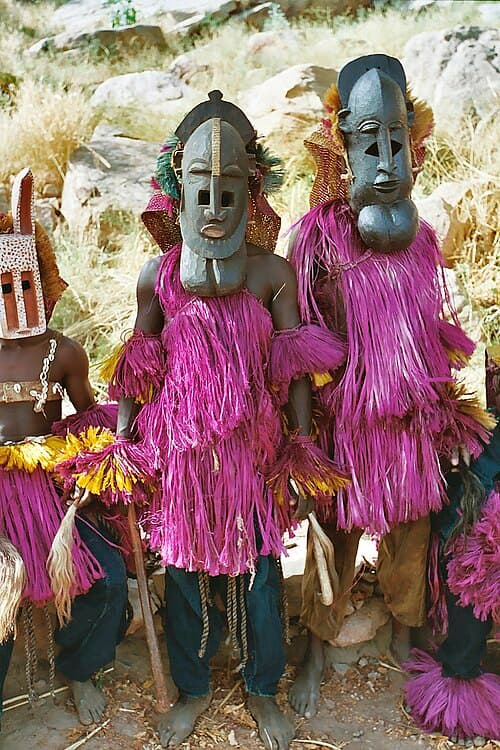
Mali
The cross-shaped Dogon mask used in Dama funeral ceremonies to guide the souls of the dead to their resting place.

Sierra Leone
Ancient carved stone figure of unknown origin found throughout Sierra Leone — used as rice fertility charms.

