

249
Protection
🎭
African Mask
Sub-Saharan Africa
Ceremonial mask used across Africa to embody spirits, invoke divine forces, and transform the masked dancer into a sacred intermediary.
4.7Learn more →

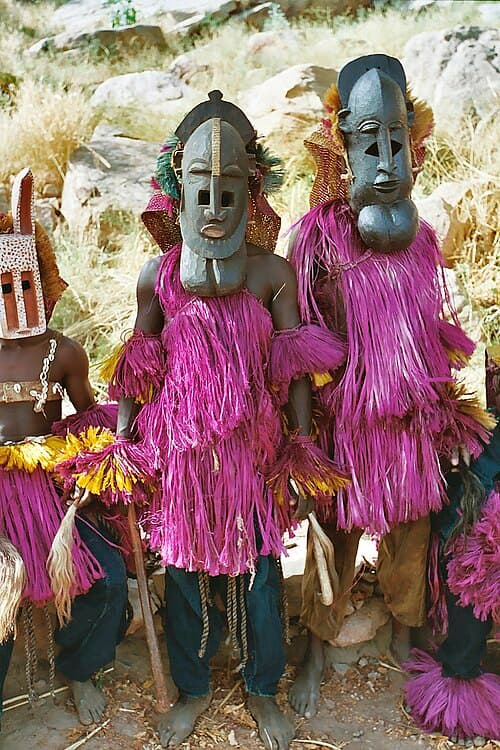
The cross-shaped Dogon mask used in Dama funeral ceremonies to guide the souls of the dead to their resting place.
The Kanaga is the most recognizable mask of the Dogon people of the Bandiagara Escarpment of Mali — a region of extraordinary beauty where Dogon villages cling to cliff faces and cave systems in a landscape that looks like another world. The Kanaga mask is characterized by its distinctive double-bar cross shape mounted on top of the face covering — a long horizontal arm with smaller vertical arms perpendicular to it. This form represents several overlapping cosmological meanings in Dogon belief: the arms of the mask depict a bird in flight (the Kanaga bird, a type of duck or crane), the shape of a man gesturing between earth and sky, and the fundamental cross-form that in Dogon cosmology represents the interface between the earth and the heavens.
The most important context for the Kanaga mask is the Dama ceremony — the elaborate Dogon funeral celebration that releases the soul of a recently deceased person to the next world and officially mourns them before the community. During Dama, which may be held years after the actual death, dozens of masked dancers perform for hours, the Kanaga masks bobbing and swaying as the dancers use the movements to sweep the soul of the deceased away from the human world and direct it toward the realm of ancestors. Without this ceremony, the Dogon believe, the soul remains trapped near its former life and can cause illness and misfortune for the living family.
The Kanaga mask represents one of humanity's most visually striking responses to the universal experience of death and the need to actively help the dead complete their journey. Its cross-shaped form — the intersection of earth and sky, of living and dead — embodies the Dogon understanding of the cosmos as fundamentally bipolar and the need for active human ritual to maintain the balance between its poles.
Guiding the dead to their proper resting place, the intersection of earth and sky, the balance between living and dead, the community's active role in completing the journey of the deceased, and the human responsibility to maintain cosmic order.
Display a Kanaga mask in a space dedicated to honoring ancestors or confronting mortality with wisdom. Use it as a meditation focus on the transience of life and the continuity of spirit. In grief work, the Kanaga can represent the active movement of a soul from the world of the living to the realm of ancestors.
The Dogon people were made famous in Western anthropology by Marcel Griaule's 1931-1956 fieldwork, which resulted in the influential (though now contested) claim that Dogon astronomical knowledge included precise details about the Sirius star system unavailable to other cultures without telescopes. While the 'Sirius Mystery' claim has been significantly revised by later scholars, it reflects the genuine sophistication and complexity of Dogon cosmological thought.
Dama ceremonies typically last several days and involve multiple stages: masked dances on the village plaza, rituals at the family compound, performances at the cliff sites, and final ceremonies at the ancestors' sacred sites. Major Dama ceremonies in important communities can last up to a week and involve hundreds of participants.
In traditional Dogon practice, only initiated men of the Awa masking society may wear Kanaga masks. Women and uninitiated people are forbidden from touching or examining the masks, which are kept in hidden caves in the cliff faces between ceremonies. Contemporary Dogon artists make replica masks for the art market, which are distinct from ceremonial masks.
Interpretations vary among Dogon elder sources. The most cited meaning is the form of the Kanaga bird with wings spread. Another interpretation depicts a figure with arms raised toward heaven and legs planted on earth — humanity as the mediating point between heaven and earth. A third reading sees the crossed bars as Dogon cosmological diagrams of the universe's structure.
Sub-Saharan Africa
Ceremonial mask used across Africa to embody spirits, invoke divine forces, and transform the masked dancer into a sacred intermediary.

Ivory Coast
The hornbill-based sacred bird figure of the Senufo people — symbol of the first living being and the power of Poro initiation.

West Africa
The sacred West African drum whose voice calls community together, invites healing, and speaks to the spirits.

