

139
Protection
🦁
Fu Dogs (Guardian Lions)
China
Fu Dogs — imperial stone lions that guard the gates of palaces, temples, and homes — are China's supreme protective talisman against evil, theft, and misfortune.
4.6Learn more →

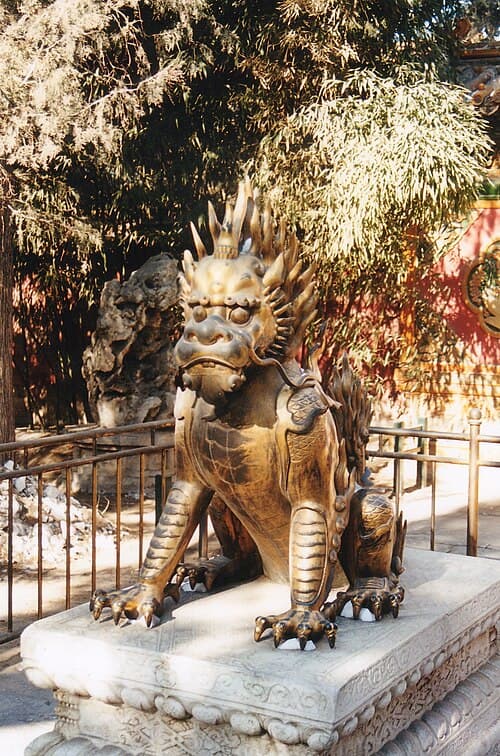
The Haetae is Korea's mythological guardian lion that eats fire and prevents disaster, symbolizing justice, protection, and the fierce defense of those under its care.
The Haetae (해태, also Haechi) is one of Korea's most ancient and architecturally significant protective beings — a mythological lion-like creature covered in scales, with a single horn on its head and the ability to eat fire, nullifying any conflagration. In Korean cosmological tradition, the Haetae is the divine guardian against fire and natural disaster, the supernatural fire-extinguisher assigned to protect important buildings from the worst fate a wooden structure could face. This is why monumental Haetae sculptures were strategically placed at the entrances of palaces, government buildings, and granaries throughout the Joseon dynasty.
The Haetae's role extends beyond fire prevention into the realm of justice. In Korean judicial tradition, the Haetae is said to be able to distinguish the guilty from the innocent infallibly — in disputes involving false accusations, the Haetae would butt its horn against the guilty party, making it the perfect emblem for the judiciary and the police. The Korean National Police Agency uses the Haetae as one of its symbols, and it serves as the official mascot of Seoul Metropolitan Government, making it one of the most institutionally embedded mythological creatures in East Asian modern governance.
As a personal protective charm, the Haetae offers the specific protection of fire safety, justice prevailing in legal disputes, and the fearless confidence of knowing one is backed by a creature that eats the most destructive element in nature. Stone Haetae figurines placed outside Korean homes have the same protective function as Chinese Fu Dogs and Okinawan Shisa but with the additional power of fire resistance encoded into the creature's very mythology.
Protection from fire and disaster, the triumph of justice over false accusation, the fearless guardian who faces the most destructive forces without flinching, and the official dignity of righteous power.
Place a Haetae figurine near the kitchen (the room most vulnerable to fire) or at the main entrance as a fire-preventing guardian. In legal or administrative contexts, keep a small Haetae at the desk as an invocation of justice and accurate judgment. For personal carry, a Haetae pendant or keychain charm is particularly recommended for those involved in legal proceedings or seeking fair treatment.
The stone Haetae statues at Gyeongbokgung Palace in Seoul are placed at the base of the main ceremonial steps specifically to protect the palace from the fire spirit believed to come from the direction of Mount Gwanaksan — their placement was calculated by the palace's geomancer to intercept the fire energy before it could reach the royal structures.
The Haetae is a composite creature, like the Chinese Pixiu or Dragon Turtle — it combines features from multiple animals to embody multiple powers simultaneously. The scales give it the imperviousness of a fish or dragon; the lion body gives it strength and ferocity; the horn gives it judicial discernment. The combination is intentional rather than contradictory.
They are related. The Haetae derives from the Chinese Xiezhi (獬豸), a justice-discerning mythological creature from ancient Chinese texts. Korea received the Xiezhi concept through cultural exchange and developed it into the distinctly Korean Haetae with its emphasis on fire-eating and palace guardianship. They share judicial symbolism but have developed independently.
Seoul selected the Haetae as its official mascot in 2008, citing its deep historical roots as the guardian of Gyeongbokgung and other city landmarks, its role as a fire-preventer relevant to urban safety, and its justice-enforcing associations appropriate for a seat of government. The friendly cartoon Haechi version was designed to make the ancient creature accessible to modern citizens and tourists.
China
Fu Dogs — imperial stone lions that guard the gates of palaces, temples, and homes — are China's supreme protective talisman against evil, theft, and misfortune.

Japan
Shisa are Okinawa's beloved lion-dog guardians, placed in pairs on rooftops and gates to ward off evil spirits and protect homes from disaster.

South Korea
The Korean Dokkaebi is a mischievous but fundamentally good-natured goblin who rewards honesty and punishes greed, serving as both a protective house spirit and a moral guardian.

South Korea
Pujok are Korean shamanistic talismans made from yellow paper with red ink inscriptions, used for protection against evil spirits, illness, and misfortune in homes and on the body.

