

139
Protection
🦁
Fu Dogs (Guardian Lions)
China
Fu Dogs — imperial stone lions that guard the gates of palaces, temples, and homes — are China's supreme protective talisman against evil, theft, and misfortune.
4.6Learn more →


Shisa are Okinawa's beloved lion-dog guardians, placed in pairs on rooftops and gates to ward off evil spirits and protect homes from disaster.
The Shisa is Okinawa's most distinctive cultural icon — a mythological creature combining the features of a lion and a dog, displayed in pairs as protective guardians on rooftops, gates, and doorways throughout the Ryukyu Islands. While clearly related to the Chinese Guardian Lions (Fu Dogs) that inspired it through the tributary relationship between the Ryukyu Kingdom and Ming dynasty China, the Shisa has developed a fully distinct Okinawan character over six centuries, reflecting the unique synthesis culture of the Ryukyu people who absorbed influences from China, Japan, and Southeast Asia while maintaining their own identity.
The traditional Shisa pair follows a specific convention: one with its mouth open (male, right side) and one with its mouth closed (female, left side). The open-mouthed Shisa breathes in good fortune and expels evil spirits; the closed-mouthed Shisa retains the good fortune that has entered. Together, they create a complete protective cycle. The materials and styles of Okinawan Shisa vary dramatically — from rough, rustic earthenware versions with individual character to refined glazed ceramic masterworks — and each craftsperson's Shisa carries their personal creative spirit as part of its protective energy.
Modern Shisa have become one of Japan's most beloved souvenir items, carrying the Okinawan character of resilience (Okinawa was devastated by World War II and rebuilt with remarkable energy), warmth, and the refusal to be intimidated by either natural disaster or supernatural threat. Colorful, often whimsical Shisa pairs are now found across Japan and internationally, maintaining their protective function while serving as friendly ambassadors of Okinawan culture.
Protection of home and family from evil spirits, the balanced guardian pair that admits good fortune and retains it, and the resilient spirit of the Ryukyu people encoded in ceramic form.
Place a pair of Shisa flanking your front door or gate: male (open mouth) on the right, female (closed mouth) on the left as you face outward. Rooftop placement is also traditional in Okinawa, particularly at the ridge peak. Indoor placement follows the same left/right convention near the main entrance. Keep them facing outward toward the street.
According to Okinawan legend, the first Shisa was a necklace charm given as a gift by a Chinese envoy to the Ryukyu king; when placed on a hilltop, it defeated a sea dragon (Niraikanai) that had been devastating a coastal village — making the Shisa simultaneously a defensive weapon and a diplomatic gift that literally saved lives.
Yes — Shisa are widely used across mainland Japan and internationally. While they originated in Okinawa's specific cultural and religious context, their function as protective guardian pairs is universally applicable. Okinawan craftspeople are generally proud that their guardians have found homes worldwide.
Male (open mouth) on the right, female (closed mouth) on the left — from the perspective of someone inside the building looking out. From an outside perspective approaching the building, the open-mouth Shisa is on your left and the closed-mouth on your right. When in doubt, think of it as: open mouth faces the direction from which threats might come first.
Traditional Okinawan belief associates larger Shisa with stronger protective power for the scale of the structure — large rooftop Shisa for public buildings, medium ones for family homes, small ones for indoor and personal use. For a private home, a medium-sized pair (15–30 cm) is considered appropriately scaled.
China
Fu Dogs — imperial stone lions that guard the gates of palaces, temples, and homes — are China's supreme protective talisman against evil, theft, and misfortune.

Japan
The beckoning cat is Japan's most iconic good-luck charm, believed to wave fortune, customers, and prosperity into any space it occupies.

Japan
The Tengu's fearsome red mask with its impossibly long nose is a Japanese protective talisman representing the ferocious guardian spirits of mountains and martial wisdom.
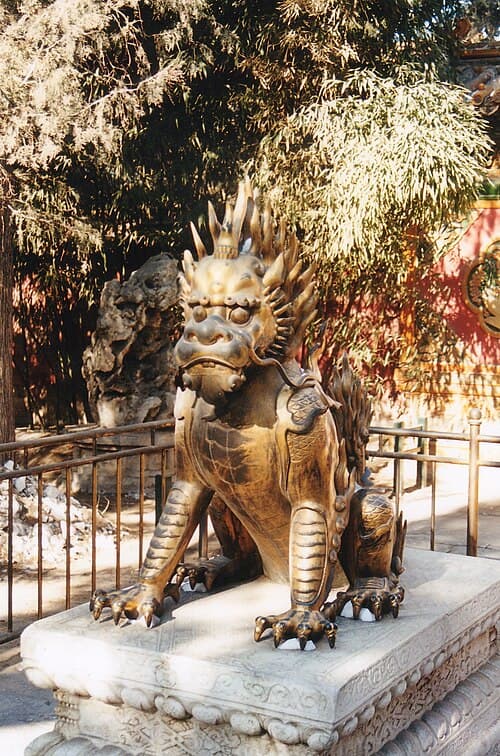
South Korea
The Haetae is Korea's mythological guardian lion that eats fire and prevents disaster, symbolizing justice, protection, and the fierce defense of those under its care.

