
5
Protection
🖐️
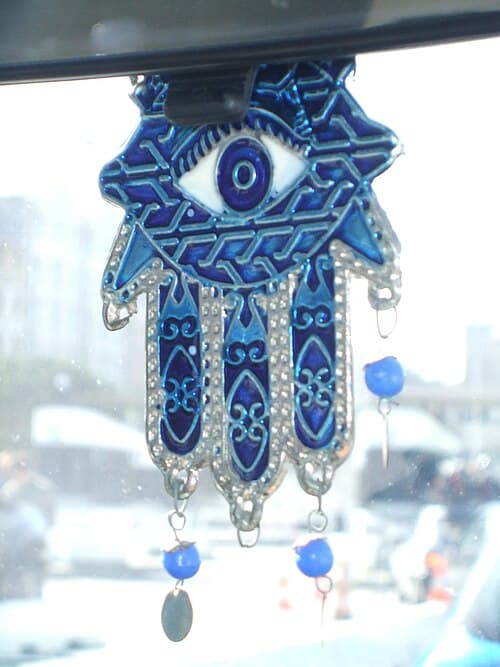
Hamsa Hand
Middle East
An open palm amulet warding off the evil eye across Middle Eastern and North African cultures.
4.9Learn more →


A blue glass bead charm that reflects the envious gaze before it can cause harm.
The Evil Eye, known as 'Nazar' in Turkish and Arabic-speaking communities and 'Ayin Hara' in Hebrew, is one of the oldest and most pervasive protective beliefs in the world, with its roots running deepest in the Middle East. The concept holds that a glance of intense envy or admiration can curse the target with misfortune, illness, or bad luck, even when the gaze is unintentional. To counter this, people carry or display a blue glass eye-shaped bead that captures and neutralizes the harmful stare.
The vivid cobalt blue of the traditional evil eye bead is not arbitrary — blue was believed by ancient peoples of the Mediterranean and Middle East to be the color most associated with the sky, divinity, and protective power. Glass-bead production for evil eye amulets became highly sophisticated in the workshops of ancient Egypt and later flourished in Turkey, Lebanon, and across the Levant. The layered glass technique used to create the concentric circles of the eye is a craft passed down through generations of artisans.
Modern versions appear as decorative wall hangings, car accessories, baby clothing pins, jewelry, and keychains. In Israel, Lebanon, and Egypt, gifting someone a Nazar bead upon a new purchase, birth, or achievement is a common social practice, acknowledging the risk of jealousy while simultaneously offering protection.
Deflection and neutralization of the evil eye curse. The bead acts as a surrogate eye — it stares back at the source of envy, confusing and returning the harmful energy. When a bead cracks or breaks, it is said to have absorbed a curse and done its protective work.
Pin a small evil eye bead to infant clothing to protect newborns, who are considered especially vulnerable. Hang a large glass evil eye in your home's entryway. Wear as a bracelet or necklace for personal protection. Replace cracked or broken beads promptly.
The world's largest evil eye bead, measuring over 45 centimeters in diameter, is displayed in a Turkish museum and required months of work by a master glassblower. In 2014, thousands of tiny evil eye beads were dropped from a helicopter over the Cappadocia region as part of an art installation — the concept of aerial protection.
A breaking evil eye bead is widely interpreted as a positive sign — it means the bead successfully absorbed a curse or intense negative energy directed at you, sacrificing itself to protect you. You should dispose of the broken pieces and replace the bead.
The evil eye is acknowledged in Islam — the Quran references 'the evil of the envier' and the Prophet Muhammad acknowledged its reality. However, Islamic scholars debate whether wearing amulets for protection is permissible, and some consider the practice pre-Islamic folk custom rather than sanctioned religious practice.
Blue was historically associated with the divine, the sky, and protective power across Mediterranean and Middle Eastern cultures. Blue-eyed people were also considered especially potent givers of the evil eye in some traditions, making blue beads the ideal symbolic counter.
Middle East
An open palm amulet warding off the evil eye across Middle Eastern and North African cultures.

Egypt
The complete, restored eye of Horus — a supreme amulet of wholeness, protection, and divine sight.

Iran
The sky-blue gemstone mined in Iran for 5,000 years, believed to protect against the evil eye and bring victory in battle.

