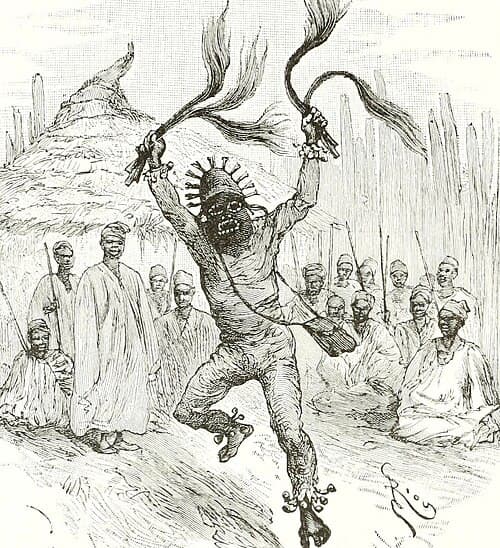
Puerto Rican Vejigante Mask
Puerto Rico (Ponce and Loรญza)
The magnificent multi-horned papier-mรขchรฉ mask of Puerto Rican Carnival tradition โ a figure who chases away evil while embodying the island's joyful, syncretic spirit.
A ceramic doll with no facial features representing the multiracial, multicultural identity of the Dominican people โ where no one face defines the whole.
The Dominican faceless doll (muรฑeca sin rostro or muรฑeca limรฉ) is one of the most philosophically compelling folk art objects in the Caribbean โ a ceramic or clay doll wearing traditional Dominican dress in colorful fabrics and carrying fruit, flowers, or baskets on her head, but with no facial features at all. The smooth, blank face where eyes, nose, and mouth should appear is not an oversight or a style choice for ease of production, but a deliberate philosophical statement about Dominican identity.
The faceless doll was created in the mid-20th century by Dominican artisans in the Higรผerito region of Moca province, and the tradition holds that the faceless form was chosen to represent the Dominican Republic's profound racial and cultural mixture. In a country shaped by indigenous Taรญno heritage, West African enslavement, Spanish colonization, and continuous immigration from across the Americas and Europe, no single face can represent everyone. The absence of features says: 'All faces are this face. Every Dominican is this doll.'
The faceless doll has become one of the Dominican Republic's most beloved cultural symbols, produced in sizes from tiny jewelry charms to large decorative pieces. They appear in Dominican homes as declarations of cultural pride, given as gifts to represent the beauty of the Dominican multicultural identity, and carried by Dominicans abroad as connections to home and heritage.

The Dominican faceless doll represents radical inclusion โ the beauty of a culture that cannot be defined by a single face because it contains all faces within it. It symbolizes the Dominican affirmation that mixed heritage is not a deficit but a richness, that the absence of a singular identity is precisely the source of the culture's creativity and resilience. It carries the energy of belonging for all.
Display a faceless doll in your home as a symbol of inclusive welcome and cultural pride. Give faceless dolls to people who are navigating questions of mixed identity or belonging, as an affirmation that their complexity is their gift. Use the image in meditation on the fluid, multifaceted nature of identity and the beauty of cultural synthesis.
The Dominican faceless doll concept has inspired similar artistic traditions in other countries with complex multicultural histories. The doll has been interpreted by Dominican-American artists in New York and other diaspora communities as a symbol specifically of diaspora identity โ the person who belongs to multiple cultures simultaneously and cannot be fully contained in any single cultural face.
The primary production center is in the Higรผerito community in the Moca province, in the Cibao region of the north. The tradition has spread throughout the country, and similar dolls are now made in many areas, but the original artisan families of Higรผerito are considered the tradition's authentic origin. Purchasing from Higรผerito artisans supports the founding community.
The colorful fabrics represent the diverse cultural influences that make up Dominican culture. There is no fixed color meaning โ the palette itself demonstrates the richness of mixing. Many artisans use fabrics that reflect their personal or regional aesthetic traditions, making each doll simultaneously a representation of universal Dominican identity and the specific community of its maker.
While the traditional form depicts a woman in typical dress, the faceless doll's philosophical meaning is universal. Some artisans now create faceless figures in various forms. The woman's form is connected to the tradition of women carrying goods on their heads โ a practice seen across the Caribbean and Africa that represents female strength, dignity, and the labor that sustains communities.
Puerto Rico (Ponce and Loรญza)
The magnificent multi-horned papier-mรขchรฉ mask of Puerto Rican Carnival tradition โ a figure who chases away evil while embodying the island's joyful, syncretic spirit.
Haiti (Haitian Vodou tradition)
Sacred geometric symbols drawn in cornmeal or flour to invoke specific Lwa (spirits) in Haitian Vodou ceremonies.
Jamaica
Jamaica's national bird โ the streamertail hummingbird โ a symbol of joy, agility, and the vibrant natural spirit of the Caribbean island.