

249
Protection
🎭
African Mask
Sub-Saharan Africa
Ceremonial mask used across Africa to embody spirits, invoke divine forces, and transform the masked dancer into a sacred intermediary.
4.7Learn more →


The sacred West African drum whose voice calls community together, invites healing, and speaks to the spirits.
The djembe is among the most powerful musical instruments in West African spiritual life. Originating with the Mandinka, Bambara, and related Mande peoples of Guinea and surrounding countries, the djembe — a goblet-shaped drum with a goat skin head — is far more than a percussion instrument. Its name derives from the Bambara phrase 'Anke djé, anke bé,' meaning 'everyone gather together in peace,' and this communal gathering function is fundamental to understanding the instrument's spiritual role. The djembe calls communities together, creates the sonic space for dance, ceremony, and healing, and serves as a vehicle for communication between the living and the spirit world.
In the Mande griot tradition, master djembe players (dunungbas and doundoumbas) are initiated musicians who have undergone years of training and spiritual preparation. The rhythms they play are not arbitrary — each rhythm corresponds to a specific spirit, deity, or purpose: rhythms for harvest, for healing, for welcoming royalty, for initiation. When a master plays these rhythms correctly, the appropriate spiritual powers are invited into the space. The drum itself, made from a sacred tree and covered with the skin of a sacrificed animal, is considered a living entity requiring care and respect. New drums are consecrated with prayers and offerings before being used ceremonially.
A miniature djembe charm or an image of the instrument is used as a luck talisman by musicians, community organizers, and healers worldwide. It represents the power of sound to transform space, the ability of rhythm to unite people, and the ancient understanding that music is fundamentally a spiritual act. For anyone working to build community or facilitate healing, the djembe is a potent ally.
Community gathering and unity, the healing power of rhythm and sound, communication with ancestral spirits through music, and the joy that sustains collective life.
Keep a small djembe charm or figure in a music space or community gathering area to invite the spirit of joyful collective energy. Play or listen to djembe music before community events to prepare the space. Use drumming meditation for personal centering and stress release.
UNESCO inscribed the art of djembe music of Mali on its Representative List of the Intangible Cultural Heritage of Humanity in 2014. A master djembe player can produce at least three distinct tones from a single drum — the bass (played in the center), the tone (struck at the edge), and the slap (a sharp crack at the rim) — each with a specific musical and spiritual function.
Many practitioners and some researchers suggest that djembe drumming facilitates stress reduction, immune function, and emotional processing. Rhythm entrains brain waves, and group drumming creates neurological synchrony among participants. These physiological effects align with the spiritual healing attributed to djembe in West African tradition.
Sacred djembe are consecrated through specific rituals at the time of their construction: prayers and offerings during the cutting of the tree, the sacrifice of a goat for the skin, and the naming and dedication of the completed instrument. These consecrated drums are not sold in tourist markets — ceremonial djembe stay in the care of initiated musicians.
Yes — the djembe tradition has always incorporated new learners and welcomes those who approach with respect. Learning basic rhythms from an authentic teacher, understanding the cultural context, and not claiming mastery of sacred repertoire without proper initiation are the key principles of respectful engagement.
Sub-Saharan Africa
Ceremonial mask used across Africa to embody spirits, invoke divine forces, and transform the masked dancer into a sacred intermediary.
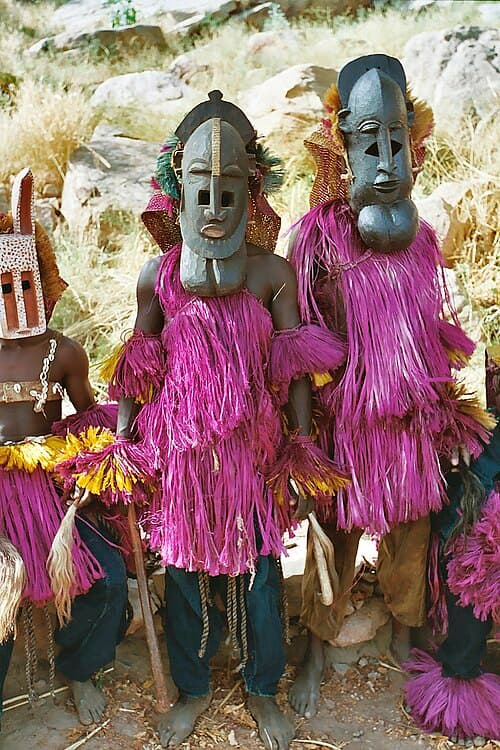
Mali
The cross-shaped Dogon mask used in Dama funeral ceremonies to guide the souls of the dead to their resting place.

West Africa / African Diaspora
The iconic West African-derived charm bag of the African diaspora, filled with herbs, stones, and intentions.

