

79
Protection
📿
Rudraksha Beads
India
Seeds of the Elaeocarpus ganitrus tree, rudraksha beads are the tears of Shiva — the most potent Hindu spiritual talisman.
4.8Learn more →

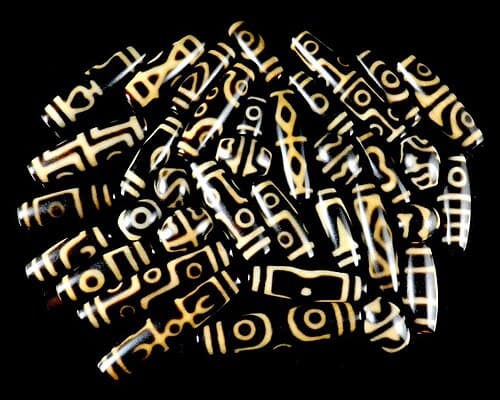
Mysterious ancient beads with eye-like patterns are among the most powerful and expensive amulets in Tibetan Buddhist tradition.
The Dzi bead (pronounced 'zee') is a type of ancient decorated stone bead found primarily in Tibet, Nepal, and Bhutan, among the most powerful and highly prized amulets in the Tibetan Buddhist world. These beads, typically agate or chalcedony, are distinguished by their surface patterns of eye-like circles, lines, and geometric designs, which appear to be etched, burned, or chemically treated into the stone using a process that modern scientists have not fully replicated. The most valuable Dzi beads are ancient — some possibly 2,000 or more years old — and command extraordinary prices: a nine-eyed Dzi of established ancient provenance can sell for tens of thousands of dollars or more.
The origin of Dzi beads is mysterious and contested. In Tibetan folk tradition, they are said to be the dried excrement of a divine worm or insect, or to have fallen from the sky, or to be the ornaments of gods that were found on earth after these divine beings passed through. Modern scientific analysis has determined that the base material is natural agate, and the patterns are created through chemical treatment and heating — but the exact ancient methods used to create the most complex designs remain unknown. The mystery of their creation has always been part of the Dzi bead's mystique and power.
Different numbers of eyes on a Dzi bead indicate different powers: the one-eyed Dzi brings personal fortune and protection, the two-eyed Dzi harmonizes relationships and brings marital bliss, the three-eyed Dzi brings wealth and longevity, and so on up to nine eyes, which is considered the most powerful and comprehensive, providing protection, wisdom, and the fulfillment of all wishes simultaneously. The nine-eyed Dzi is correspondingly the most sought-after and expensive variety.
Comprehensive supernatural protection, specific blessings based on the number of eyes, and a direct connection to Tibetan cosmological power accumulated over centuries of use.
Wear the Dzi bead as a pendant or as part of a mala around the neck or wrist. Handle it with respect and avoid letting others wear it. Clean gently with a soft cloth only — no chemicals. Store separately from other beads when not wearing. Bring it to a lama for blessing when first obtaining the bead.
The Dzi bead market is notorious for sophisticated fakes — modern reproductions made from ancient-looking treated agates can fool all but the most expert eyes. Genuine ancient Dzi beads develop a distinctive 'skin' (coating of mineral deposits) over centuries that is nearly impossible to fake completely. Expert evaluators study the skin, the depth of pattern etching, and the material's response to specific tests.
Genuine ancient Dzi develop a powdery coating or skin (called the 'weather skin') over centuries. Under magnification, authentic Dzi show the pattern penetrating into the stone's surface rather than sitting on top of it. The weight should feel substantial for the size. Authentic ancient beads also show natural wear patterns consistent with age — not artificially aged.
Yes. The two-eyed Dzi is associated with Avalokiteshvara (compassion). The three-eyed Dzi is associated with Kubera (wealth). The nine-eyed Dzi is associated with the nine Yidam deities (meditation deities). Different sources provide somewhat varying attributions, but the general principle of each number corresponding to a specific divine force is consistent across traditions.
Practitioners point to three factors: the extreme age of genuine beads (centuries of accumulation of prayers, blessings, and merit from previous wearers), the mysterious and apparently supernatural pattern-creation process (which practitioners interpret as evidence of divine manufacture), and the specific sacred geometry of the eye-patterns, which are believed to create directional protective fields.
India
Seeds of the Elaeocarpus ganitrus tree, rudraksha beads are the tears of Shiva — the most potent Hindu spiritual talisman.

India
Nine sacred gemstones linked to the nine celestial bodies, worn together to balance cosmic influences and attract total fortune.

India
A string of 108 prayer beads used for mantra repetition, mala beads align the practitioner's energy with divine intention through meditative counting.

Nepal
Metal bowls that produce healing resonant tones when struck or rimmed are used for meditation, sound healing, and space purification.

