

187
Protection
💎
Persian Turquoise
Iran
The sky-blue gemstone mined in Iran for 5,000 years, believed to protect against the evil eye and bring victory in battle.
4.7Learn more →


The winged divine figure of Zoroastrian Iran, symbol of good thoughts, good words, and good deeds.
The Farvahar (also called Farohar or Faravahar) is the most iconic symbol of Zoroastrianism, one of the world's oldest monotheistic religions, founded by the prophet Zoroaster (Zarathustra) in ancient Iran. The symbol depicts a human figure emerging from a winged disc, holding a ring in one hand while the other gestures forward — it represents the Fravashi, the divine guardian spirit that accompanies each human soul as a guide and protector. The Farvahar was the royal emblem of the Achaemenid Persian Empire (550-330 BCE), appearing at Persepolis and on the cliff carvings of Naqsh-e Rustam, and was associated with the great emperors Cyrus, Darius, and Xerxes.
The symbol's components carry precise philosophical meaning: the three layers of feathers represent the three central principles of Zoroastrianism — good thoughts (humata), good words (hukhta), and good deeds (huvarshta). The two streamers beneath the wings represent the choice between good and evil that every human must make. The ring held in the figure's hand represents the covenant of righteousness and the circular, eternal nature of divine order. The tail feathers represent rejection of evil thoughts, evil words, and evil deeds. Every element is a condensed lesson in the Zoroastrian ethical system.
For Iranian people of all backgrounds — Zoroastrian, Muslim, secular — the Farvahar has become a powerful symbol of Persian cultural identity and civilizational pride. Wearing it announces connection to Iran's pre-Islamic heritage and the extraordinary philosophical civilization of ancient Persia, which gave the world the first recorded declaration of human rights (Cyrus Cylinder, 539 BCE).
The Zoroastrian triad of good thoughts, good words, and good deeds; the eternal human responsibility of free moral choice; and connection to the glorious civilizational heritage of ancient Persia.
Wear as a pendant to honor Iranian cultural heritage and the Zoroastrian ethical principles regardless of personal religious practice. Display in a home or office as a reminder of the three principles — think well, speak well, act well — as a daily ethical compass. Gift to Iranians as a celebration of Persian cultural identity.
The Cyrus Cylinder, created by the Achaemenid Persian emperor Cyrus the Great in 539 BCE and now housed in the British Museum, is widely considered the world's first charter of human rights — it proclaimed freedom of religion and abolished slavery in Babylon. The same civilization that produced the Farvahar produced this landmark of human freedom.
Both, with the balance varying by individual. For Zoroastrians it is deeply religious, representing the divine guardian spirit and the core ethical principles of the faith. For many secular Iranians and those of Muslim background, it has become a symbol of pre-Islamic Persian cultural identity and civilizational pride rather than specifically religious practice.
Zoroastrianism is one of the world's oldest monotheistic religions, founded by the prophet Zoroaster in ancient Iran, likely between 1500-1000 BCE. Its central belief is in one supreme god (Ahura Mazda), a cosmic struggle between good and evil, and human moral responsibility. It significantly influenced Judaism, Christianity, and Islam through its concepts of angels, judgment, heaven and hell, and the messiah.
The most famous Farvahar carvings are at Persepolis (the ancient Achaemenid capital) and Naqsh-e Rustam (the royal necropolis near Persepolis), both in the Shiraz region of Fars Province. Pasargadae, the tomb of Cyrus the Great, also has Farvahar imagery. All three are UNESCO World Heritage Sites.
Iran
The sky-blue gemstone mined in Iran for 5,000 years, believed to protect against the evil eye and bring victory in battle.

Iran
The teardrop-shaped motif from ancient Persia that conquered the world's textile traditions and became a global symbol of flowing beauty.
Iran
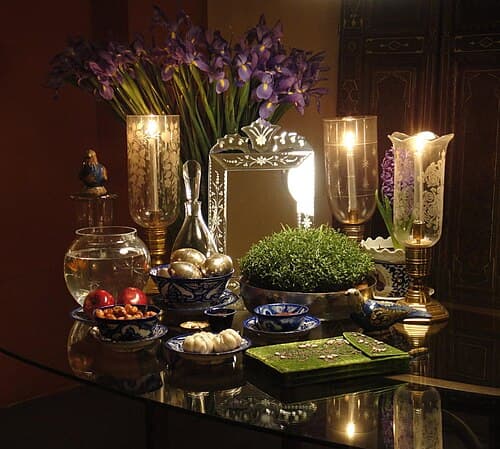
A miniature of the Persian New Year's sacred table of seven symbolic items, inviting abundance and renewal.

