

185
Success
🦅
Persian Farvahar
Iran
The winged divine figure of Zoroastrian Iran, symbol of good thoughts, good words, and good deeds.
4.6Learn more →

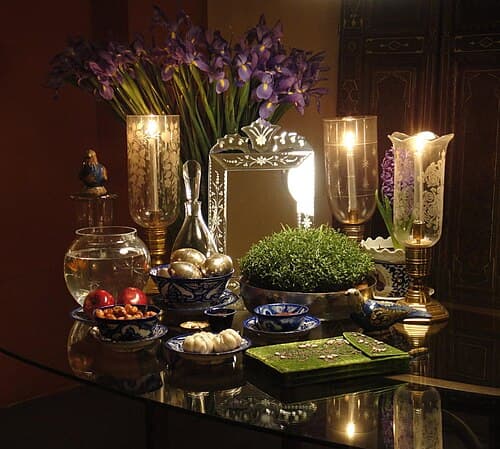
A miniature of the Persian New Year's sacred table of seven symbolic items, inviting abundance and renewal.
Nowruz — Persian New Year, celebrated on the spring equinox (around March 21) — is one of the world's oldest and most beautiful celebrations, a holiday of renewal shared by people across Iran, Afghanistan, Tajikistan, and much of Central Asia regardless of religious background. The Haft-Sin (seven S's) is the ritual table of seven items whose names begin with the Persian letter 'S' (sin), each representing an aspect of abundance and hope for the new year: sabzeh (sprouted wheat/lentils, representing rebirth), samanu (wheat pudding, for affluence), senjed (dried oleaster fruit, for love), seer (garlic, for medicine and health), seeb (apple, for beauty and health), somaq (sumac, for sunrise and the coming of the day), and serkeh (vinegar, for patience and age).
Additional items typically placed on the Haft-Sin table — though not all starting with S — include painted eggs (fertility), a goldfish in a bowl (life), a mirror (sky), candles (enlightenment), a holy book (spiritual guidance), coins (prosperity), and often a copy of the Persian epic poem Shahnameh by Ferdowsi. The entire composition becomes a visual prayer for the new year, a comprehensive wish for every dimension of a good life assembled in one beautiful arrangement.
Miniature Haft-Sin charms and plate ornaments carry the energy of this beautiful renewal tradition — they are particularly meaningful gifts for Nowruz but can be kept year-round as reminders of the Persian philosophical belief that renewal is always available, spring always returns, and abundance comes to those who prepare their table with intention.
Complete renewal, the welcoming of spring's returning abundance, and the conscious preparation of a life table that honors health, love, beauty, patience, prosperity, and spiritual connection simultaneously.
Set up a full Haft-Sin table at Nowruz to celebrate Persian New Year and invite the seven forms of abundance into the new year. Keep a miniature Haft-Sin charm as a year-round reminder of these seven values. Gift to Iranian friends at Nowruz as a blessing of comprehensive abundance.
Nowruz has been celebrated for at least 3,000 years and is now recognized by UNESCO as an Intangible Cultural Heritage of Humanity. It is celebrated by over 300 million people across a vast geographic swath from the Balkans to western China, making it one of the most widely observed holidays in the world — and one of the most obscure to those outside its cultural sphere.
Nowruz (meaning 'new day' in Persian) is the Persian New Year celebrated on the spring equinox, around March 21. It is 3,000+ years old, predating Islam, and is celebrated across Iran, Afghanistan, Tajikistan, Kurdistan, Azerbaijan, and diaspora communities worldwide. It celebrates renewal, spring, and the triumph of light over darkness.
The tradition's exact origin is debated. Some scholars believe the 'seven S's' replaced an older 'seven shine's' (items beginning with 'sh') tradition. The number seven is sacred in Persian and Zoroastrian tradition, and the alliterative structure makes the table's items memorable and the tradition teachable across generations.
No — Nowruz is celebrated by over 300 million people including Afghans, Tajiks, Kurds, Azerbaijanis, Kazakhs, Uzbeks, Turkmen, and diaspora communities worldwide. The UN designated it an International Day of Nowruz in 2010. In 2016, UNESCO added it to the Representative List of Intangible Cultural Heritage of Humanity.
Iran
The winged divine figure of Zoroastrian Iran, symbol of good thoughts, good words, and good deeds.

Iran
The sky-blue gemstone mined in Iran for 5,000 years, believed to protect against the evil eye and bring victory in battle.

Iran
The teardrop-shaped motif from ancient Persia that conquered the world's textile traditions and became a global symbol of flowing beauty.

