

2
General
🍀
Four-Leaf Clover
Ireland
The rarest clover mutation, treasured as nature's own lucky charm.
4.9Learn more →


The mischievous fairy cobbler who guards a pot of gold at the rainbow's end.
The leprechaun is one of the most distinctive figures in European fairy mythology — a small, solitary fairy craftsman, traditionally depicted as an elderly male dressed in green, who spends his time mending shoes. His importance as a luck figure derives from the treasure he is said to keep: a pot of gold hidden at the end of a rainbow, which can be claimed by any mortal clever enough to catch him and hold him without blinking until he reveals its location.
In original Irish folklore (as distinct from modern popular imagery), leprechauns were not exclusively green — red was equally traditional — and they were creatures of genuine power and unpredictable temperament, to be approached with respect and caution. They belonged to the Tuatha Dé Danann, the supernatural race of beings who retreated underground when the Celts arrived in Ireland, and their shoe-mending was interpreted as evidence of their constant travel between this world and the fairy realm.
The leprechaun's association with luck is paradoxical and interesting: he is not naturally benevolent. His treasure must be won through cunning and vigilance, and he will use every trick at his disposal to escape capture. This makes him a symbol of luck as something active and pursued rather than passively received — the fortune of someone quick-witted enough to seize their opportunity and hold it fast.
The leprechaun represents the elusive nature of wealth and the way that fortune rewards those quick, clever, and persistent enough to pursue it. He embodies the playful, trickster energy of fairy magic — neither wholly good nor bad, but a force that tests the seeker. As a cultural symbol, he represents Irish wit, independence, and the conviction that beneath this world's surface lies a richer, more magical one.
Leprechaun figurines and imagery are placed in homes and gardens as whimsical symbols of luck, particularly around St Patrick's Day. In Irish tradition, leaving a small offering of milk or bread at the threshold is said to appease the little people and encourage them to leave good fortune in return. Leprechaun charms on bracelets and keychains are popular souvenirs that carry the wish for a lucky find.
The leprechaun's shoe-mending occupation is not random folklore detail. In fairy tradition, shoes were associated with travel between worlds, and the sound of fairy cobblers at work — a faint tapping — was one of the ways humans might detect their presence. Following the sound could lead to an encounter and potential access to the hidden treasure.
The pot of gold at the rainbow's end is the most famous element of leprechaun legend, but in older folklore the leprechaun's treasure took various forms — sometimes a purse with a magical coin that always returned, sometimes a buried hoard. The rainbow-pot association became dominant in the 19th century.
In fairy tradition, supernatural beings could only be controlled while the human maintained direct eye contact. The moment you blinked or looked away, the leprechaun's enchantment would reassert and he would vanish along with any promise he had made about his treasure.
Yes — the leprechaun is uniquely Irish. While other European fairy traditions have analogous small supernatural craftsmen, the leprechaun with his specific set of characteristics and the pot-of-gold mythology is distinctly of Irish origin and is not found in the same form elsewhere.
Ireland
The rarest clover mutation, treasured as nature's own lucky charm.
Ireland
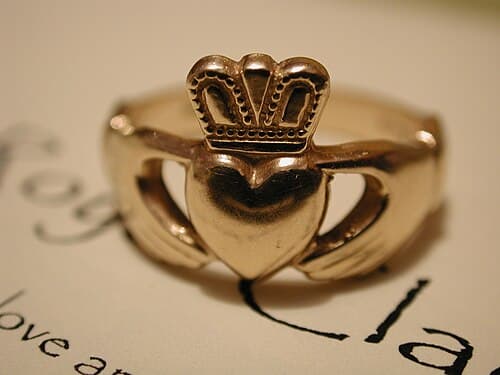
The Irish ring of hands, heart, and crown declaring love, loyalty, and friendship.

Ireland
The ancient triple spiral of the Celts, encoding the threefold nature of reality.

