
238
Protection
🔱
Haitian Veve
Haiti (Haitian Vodou tradition)
Sacred geometric symbols drawn in cornmeal or flour to invoke specific Lwa (spirits) in Haitian Vodou ceremonies.
4.7Learn more →

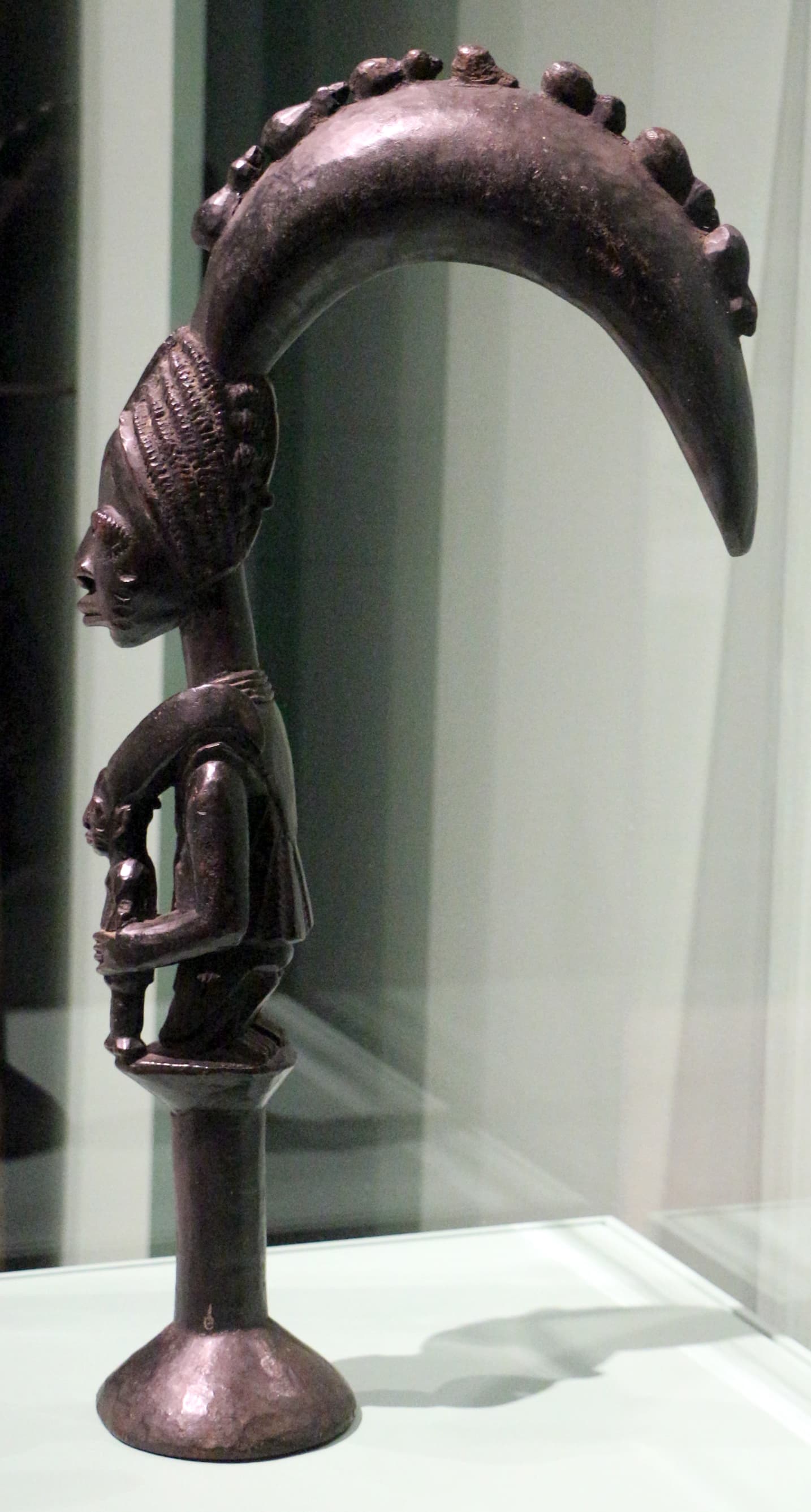
The Orisha of crossroads, doors, and beginnings in Cuban Santería — the trickster guardian who must be honored first in all ceremonies.
Elegua (also spelled Elegguá or Exu) is perhaps the most important Orisha in Cuban Santería (Lucumí/Regla de Ocha), the Afro-Caribbean religion developed by enslaved Yoruba people brought to Cuba who maintained their spiritual practices under the cover of Catholic saint imagery. Elegua is the Orisha of crossroads, doorways, beginnings, and communication — the divine trickster who opens or closes all paths in life. Without his permission, no ceremony can proceed and no spiritual work can succeed. He is always honored first and last in any ritual context.
Elegua's physical representation (his otán or sacred stone) is typically kept in a small clay pot or behind the front door of a practitioner's home, given regular offerings of rum, tobacco, candy, and coconut. He is depicted as simultaneously a mischievous child and a wise old man — his duality represents the cycle of life, and his trickster nature teaches that the boundary between help and hindrance depends entirely on whether you have properly honored the guardian of the way.
Syncretized with the Catholic figure of the Holy Child of Atocha (Santo Niño de Atocha) and with Saint Anthony of Padua, Elegua represents one of the most complex and beautiful examples of Afro-Caribbean religious synthesis — a Yoruba deity maintaining his essential nature while wearing Catholic robes as protective camouflage during centuries of religious persecution.
Elegua represents the principle that nothing happens without traversing a threshold, and that the guardian of all thresholds must be acknowledged and honored for pathways to open. He embodies beginnings, choices at crossroads, and the communication between the human and divine worlds. Honoring Elegua means acknowledging that the universe has gatekeepers whose cooperation must be cultivated.
If you are a Santería practitioner, follow the specific protocols given by your godparent for working with Elegua. If you are not initiated but want to honor this energy, place a small ceramic figure of a child or old man near your front door with offerings of candy and coconut pieces. Light a candle in red and black (his colors) and speak respectfully, asking for your paths to be opened.
There are 21 roads (caminos) of Elegua in Santería, each a different aspect of this Orisha with different personality, offerings, and sphere of influence. Eshu Laroye is the childlike road associated with pure luck and openings. Eshu Bi is a fierce warrior road. Eshu Agongo Ogo is associated with crossroads of life and death. This multiplicity within a single Orisha reflects Yoruba theology's sophisticated understanding of divinity as multifaceted.
In Santería, formal initiation (receiving your Elegua) is considered essential to working properly with this Orisha. Without initiation, you may honor Elegua respectfully but should not attempt to 'work with' him in a ritual sense without guidance from an initiated practitioner (aborisha or olorisha). The religious system has protocols that exist for good reason.
Elegua's primary colors are red and black, representing the crossroads between life and death, creation and destruction. His sacred number is 3 (for younger roads) or 21 (for the total number of his roads). His day of the week is Monday. Offerings include candy, rum, tobacco, coconut, and small toys. His sacred tool is a garabato (hooked stick or hook) representing his ability to open any path.
Elegua (Yoruba Eshu) and Brazilian Exu derive from the same Yoruba deity but have developed distinctive personalities in their respective Cuban and Brazilian contexts. Cuban Elegua is more strongly associated with roads and pathways. Brazilian Exu, particularly in Quimbanda, has taken on more complex associations with urban crossroads, money, and sometimes more ambivalent magic. Both retain their role as divine messengers and threshold guardians.
Haiti (Haitian Vodou tradition)
Sacred geometric symbols drawn in cornmeal or flour to invoke specific Lwa (spirits) in Haitian Vodou ceremonies.

Brazil (from Yoruba tradition)
Sacred beaded necklaces (elekes) specific to each Orixá deity in the Afro-Brazilian Candomblé tradition, worn by initiates as signs of divine protection.

Brazil (Umbanda and Quimbanda tradition)
The powerful feminine spirit of Umbanda associated with love, sexuality, crossroads, and the protection of women — a uniquely Brazilian spiritual entity.

