

249
Protection
🎭
African Mask
Sub-Saharan Africa
Ceremonial mask used across Africa to embody spirits, invoke divine forces, and transform the masked dancer into a sacred intermediary.
4.7Learn more →

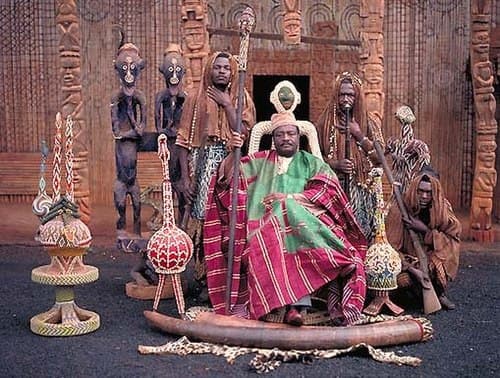
The distinctive royal mask of the Cameroon Grasslands kingdoms — worn only by royalty and their chosen societies.
The kingdoms of the Cameroon Grasslands — including the Bamileke, Bamum, Tikar, and related chieftaincies — produced some of the most distinctive royal art in sub-Saharan Africa. The masks of the Grasslands tradition, often featuring a distinctive beaded surface, large protruding eyes, and elaborate crest forms, were and remain the exclusive property of royal courts and the powerful society organizations (camwood societies, elephant societies) that support royal power. Unlike many other African mask traditions where the mask dancer remains anonymous, Grasslands masks are explicitly royal: they appear at the funerals of chiefs, at enthronements, and at annual royal festivals to display the power and continuity of the royal lineage.
Grasslands royal masks are notable for their use of colorful beadwork — thousands of small glass beads covering the entire surface of the mask in patterns of blue, red, white, yellow, and black. These colors correspond to specific royal meanings: blue for royalty and sky power, red for life force and sacrifice, white for ancestral presence and purity. The elephant motif is particularly common in the most powerful Grasslands masks, as the elephant is the king of animals and the primary symbol of royal power in this region. Elephant trunk and ear shapes, and sometimes full elephant face masks, appear in the most prestigious ceremonial contexts.
As objects of cultural heritage, Grasslands masks represent the extraordinary political sophistication of Cameroonian kingdom systems — societies that maintained complex governance, trade networks, and artistic programs for centuries before European contact. As protective charms, their association with royal power and ancestral legitimacy makes them potent symbols of authority, protection, and the power of recognized community leadership.
Royal authority and ancestral legitimacy, the protective power of divine kingship, community solidarity behind legitimate leadership, and the magnificent artistic expression of political power.
Display Cameroon Grasslands masks in leadership spaces — board rooms, offices of community leaders, and spaces dedicated to governance — to invoke the spiritual principles of legitimate authority and protective strength. Use them as meditation focal points for developing leadership qualities rooted in community service.
The Bamum kingdom of Cameroon's Sultan Njoya (c. 1875-1933) invented his own writing system (the Bamum script, also called Shu Mom) in approximately 1896 — one of the very few independently invented writing systems in African history. Njoya also wrote a history of his kingdom and a book on traditional medicine and customs in this script, demonstrating the extraordinary intellectual vitality of the Cameroon Grasslands royal tradition.
The primary distinguishing feature is the extensive beaded surface — Grasslands masks are often fully covered in glass bead embroidery, which is unusual in African mask traditions. The explicit royal context (masks are court property, not community property) and the prominence of elephant symbolism are also distinctive features.
Yes — helmet masks worn over the entire head, face masks worn in front of the face, and cap masks worn on top of the head are all found in Grasslands tradition. Each type has different social contexts and levels of sacred power. The most powerful types are reserved for the highest ceremonial contexts.
The Kwifon (or Kwifor) is the most powerful of the regulatory societies in many Grasslands kingdoms — a council of senior men who advise the chief and enforce community law. The Troh (elephant society) is the highest royal society. Membership in these societies is linked to specific mask privileges and the right to perform certain ceremonies.
Sub-Saharan Africa
Ceremonial mask used across Africa to embody spirits, invoke divine forces, and transform the masked dancer into a sacred intermediary.

Congo
Kongo power figure bristling with nails that activate its protective power and bind agreements between parties.

Ghana
Miniature brass figures used to weigh gold dust — encoding Akan proverbs and wisdom in tiny sculptural form.

