

14
Success
🎎
Daruma Doll
Japan
The round, roly-poly Daruma doll is Japan's symbol of perseverance — you set a goal, paint one eye, and complete the other only when the goal is achieved.
4.8Learn more →

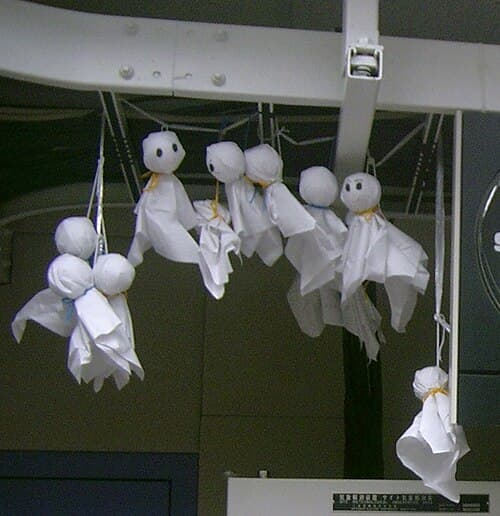
Teru Teru Bozu are small white cloth ghost-like dolls hung from windows by Japanese children to wish away rain and invite sunshine for the next day's important outdoor event.
Teru Teru Bozu (てるてる坊主, literally 'shine shine monk') are among Japan's most charming and unmistakably specific folk charms — small white balls of cloth or paper, gathered at the 'neck' with a string, resembling a round-headed ghost figure, hung from window frames and eaves to petition for good weather. Their use is most strongly associated with children and school culture: a child who wants sunshine for a field trip, sports day, or festival will make a Teru Teru Bozu the night before and hang it outside with a sung prayer for clear skies.
The name 'bozu' (monk) connects the charm to an origin story involving a Heian-period Buddhist monk who promised the emperor he could stop incessant rains threatening the harvest. The monk prayed for three days, but the rain continued. The enraged emperor had the monk beheaded, wrapped in white cloth, and hung from a tree — whereupon the skies immediately cleared. The hung white-clad bundle became a template for weather petitions, though the modern child's version has lost all of the grisly original details in favor of the charming ghost-doll form.
A subtler tradition involves the direction in which the Teru Teru Bozu is hung: if hung right-side up, it is asking for sun; if hung upside down (called 'Furi Furi Bozu'), it is asking for rain — a modification particularly used by farmers wanting irrigation rain and by children who want a snow day canceling school. This bidirectional function makes the charm one of the few traditional luck objects in Japan that can petition for weather in either direction depending on the petitioner's needs.
The child's trust that sincerely expressed wishes affect the world, the magical cooperation between human intention and natural forces, and the sweet optimism that the skies will be kind to whatever we have planned.
Hang a white cloth or paper Teru Teru Bozu outside a window or from an eave the night before any outdoor event for which you need clear weather. Make it yourself from a simple square of white tissue or cloth: place a ball of stuffing inside, gather the corners, and tie at the 'neck.' Children traditionally draw a simple smiley face on the head. Sing the traditional song (Teru Teru Bozu, teru bozu...) while hanging it for maximum effect.
The Teru Teru Bozu song (written by poet Asahi Kikutaro in 1921 and set to music by Nakayama Shinpei) became one of Japan's most-sung children's songs — but the original second verse, in which the monk who failed to bring sunshine is beheaded and buried with sake, was quietly dropped from all published versions after the Meiji period in favor of the gentler ending most children know today.
Yes — handmade Teru Teru Bozu are considered much more effective than purchased ones, because the act of making it while thinking about the hoped-for sunshine is the core ritual. The charm is as much about the child's focused intention and trust in the process as it is about the physical object. The simpler and more heartfelt the construction, the more effective it is considered.
If the weather was good, tradition says to thank the Bozu and then either burn it or send it down a river as an expression of gratitude and release. If the weather was bad (the Bozu failed), some traditions say to hang it upside down as a mild scolding, while others simply thank it and release it with the understanding that it tried its best.
Absolutely — while the tradition is most associated with children, adults hang Teru Teru Bozu for wedding days, outdoor ceremonies, sports events, and festivals with complete cultural acceptance. A Teru Teru Bozu hanging in an adult's window is charming and culturally appropriate, not childish. The straightforward sincerity of the tradition is considered appealing regardless of age.
Japan
The round, roly-poly Daruma doll is Japan's symbol of perseverance — you set a goal, paint one eye, and complete the other only when the goal is achieved.

Japan
Omamori are sacred Japanese amulets sold at Shinto shrines and Buddhist temples, offering specific divine blessings for love, safety, success, health, or any of dozens of specialized needs.

Japan
Ema are small wooden votive plaques purchased at Japanese shrines, inscribed with personal wishes, and left hanging at the shrine for the gods to read and fulfill.

Japan
A miniaturized version of the Maneki-neko's famous beckoning gesture, the lucky cat paw charm captures the essence of the invitation in a small, portable talisman.

