Miraculous Medal
France (Paris)
The Miraculous Medal is one of the most widely distributed religious medals in history, given to millions worldwide as a charm for divine grace, healing, and the special intercession of the Virgin Mary.
The scapular is a Catholic devotional garment — a small piece of wool worn over the shoulders — promised by the Virgin Mary to offer protection and salvation to those who wear it faithfully.
The Brown Scapular of Our Lady of Mount Carmel is the most widely used of eighteen different scapulars in the Catholic tradition. According to Carmelite tradition, the Virgin Mary appeared to St. Simon Stock, head of the Carmelite Order, in Cambridge, England in 1251 CE and gave him a small brown scapular (a miniature of the monks' working garment), promising: 'Whosoever dies clothed in this shall not suffer eternal fire.' This promise — the Sabbatine Privilege — has made the scapular one of the most sought-after protective devotional objects in Catholic history.
The original monastic scapular was a long piece of cloth worn over the habit covering front and back, tied at the shoulders. The lay devotional scapular was miniaturized to two small rectangles of brown wool connected by strings and worn under the clothing over the shoulders. Modern versions include cloth squares, plastic cards, and medal versions. The scapular was enormously popular among Catholic soldiers in both World Wars, and many soldiers reported protective experiences they attributed to it.
The scapular is worn continuously day and night as a sign of consecration to Mary and trust in her intercession. It is a living, wearable prayer — a physical commitment to a specific relationship with the divine feminine that is renewed with every moment of wearing.

Marian protection, consecration to Mary, perseverance in faith, protection from eternal harm, and the wearing of a physical vow of devotion.
Wear the scapular continuously under your clothing as a constant act of Marian devotion. Have the scapular enrolled (formally given and explained) by a priest or authorized person for the full devotional commitment. Replace the scapular when the wool becomes too worn, transitioning to a medal scapular if preferred.
The Brown Scapular was worn by Pope John Paul II throughout his papacy and was reportedly cut off him before surgery after the 1981 assassination attempt — the surgical team, who had to remove it to operate on his abdomen, noted that he was unconscious but still wearing it beneath his papal vestments.
The scapular is intended for any Catholic who wishes to be dedicated to Mary's protection. It does require a formal enrollment, but that is a simple ceremony, not an advanced commitment.
Yes. Pope Pius X approved the scapular medal as a valid substitute for the cloth scapular in 1910. The medal shows the Sacred Heart of Jesus on one side and Mary on the other.
The Brown Scapular is the most common, but there are seventeen other approved scapulars in different colors, each associated with different religious orders and Marian titles. The Blue Scapular of the Immaculate Conception and the Red Scapular of the Passion are other well-known examples.
France (Paris)
The Miraculous Medal is one of the most widely distributed religious medals in history, given to millions worldwide as a charm for divine grace, healing, and the special intercession of the Virgin Mary.
Medieval Europe
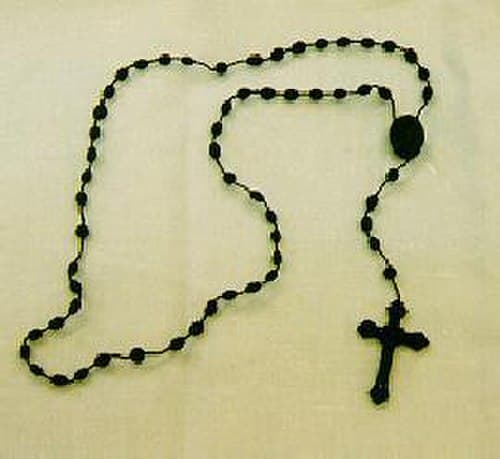
Rosary beads are the most recognizable Catholic prayer tool in the world, used by hundreds of millions for meditative prayer, protection, and the invocation of divine grace.
Early Christianity (Rome)
The Crucifix — a cross bearing the corpus (body) of Christ — is the central symbol of Christianity and one of the most powerful protective charms in the Western world.