

191
Success
🦅
Arabian Falcon
UAE / Saudi Arabia / Qatar
The sacred hunting bird of the Arabian Peninsula, a symbol of power, precision, and the noble Bedouin tradition of falconry.
4.7Learn more →


The curved Saudi sabre from the Kingdom's flag, a symbol of justice, courage, and the unified Arabian nation.
The Saudi sword — a traditional Arabic sabre called 'saif' — holds the unique distinction of being one of only two national flags in the world to feature a weapon (the other being Mozambique). The Saudi Arabian flag shows the Shahada (Islamic declaration of faith) in white Arabic calligraphy above a horizontal sword, both on a green background representing Islam. The sword beneath God's declaration is not accidental — it represents that the declaration of faith is backed by the power and willingness to defend it, that the Kingdom of Saudi Arabia is founded on both religious conviction and the political and military power to protect and project that conviction.
In the history of the Arabian Peninsula, the sword was the primary tool of both tribal justice and tribal honor — disputes were settled by the sword when other means failed, and the quality of a man's sword and his skill with it were indicators of his character and social standing. The founding of Saudi Arabia by Ibn Saud involved genuine military campaigns across the peninsula between 1902 and 1932, making the sword historically accurate as a symbol of the Kingdom's establishment through force of arms. The traditional Saudi sword dance (ardah) performed at celebrations still features swords, connecting modern ceremony to ancient military tradition.
Saudi sword charms carry the energy of righteous defense, courage in the face of adversity, and the protection of what is most sacred. They are particularly meaningful for those who need reminders of their own strength and right to defend their boundaries and beliefs.
Righteous defense of sacred conviction, the courage to stand for what is true, and the power that enables justice rather than merely wishing for it. The sword beneath God's word says: we will defend this.
Carry a sword charm when facing situations requiring courage and clear boundaries. Gift to someone who needs a reminder of their personal power and right to defend themselves. Display in a home where protection of family and values is a primary concern. Use as a meditation object when building courage and resolve.
The Saudi national flag is one of the only national flags that is intentionally never flown at half-mast — since the flag bears the Shahada (declaration of faith in Islam), lowering it is considered disrespectful to the divine declaration it bears. At the death of Saudi monarchs, black banners are displayed separately rather than lowering the national flag.
The sword represents the authority of the Saudi state and its willingness to enforce and defend the Shahada (declaration of faith) that appears above it. It symbolizes justice, as the sword is traditionally the instrument of justice in Islamic governance. It also honors the military campaigns by which Ibn Saud unified the Arabian Peninsula.
The ardah is a traditional Saudi folk dance performed with swords at major celebrations including National Day and weddings. Participants stand in two rows facing each other, brandishing swords while a poet recites verses of courage and pride. UNESCO recognized Saudi ardah as Intangible Cultural Heritage in 2015.
The traditional Saudi sabre is a curved sword (saif) with a single-edged blade, typically decorated with silver or gold-inlaid hilts and scabbards. Fine examples are considered works of art as well as weapons. The art of Arabian sword-making, using techniques from Damascus and Toledo, created blades of extraordinary quality.
UAE / Saudi Arabia / Qatar
The sacred hunting bird of the Arabian Peninsula, a symbol of power, precision, and the noble Bedouin tradition of falconry.

Saudi Arabia / UAE
The world's oldest and most beautiful horse breed, a Bedouin symbol of loyalty, speed, and noble spirit.
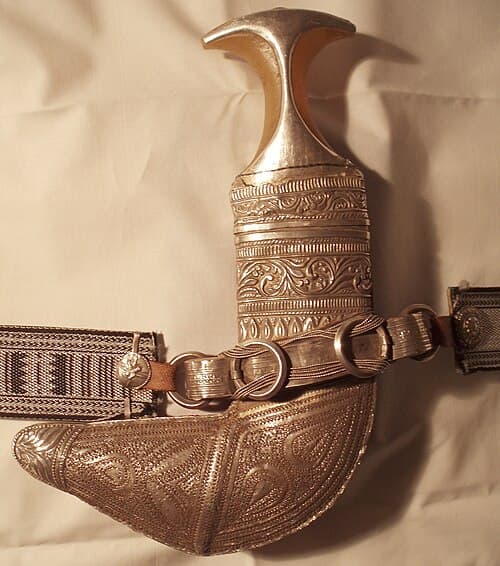
Oman
The curved ceremonial dagger of Oman, so central to national identity it appears on the national emblem.

