

22
Success
🐉
Dragon
China
The Chinese dragon is the supreme symbol of imperial power, auspicious fortune, and the dynamic yang energy that drives all achievement and transformation.
4.8Learn more →


The Ru Yi scepter — its name literally meaning 'as you wish' — is China's ultimate symbol of authority, fulfilled ambitions, and the power to make everything proceed according to one's will.
The Ru Yi (如意, literally 'as you wish' or 'as the heart desires') is one of China's most elegant and philosophically charged luck symbols — a curved scepter-like object whose S-shaped form culminates in a head shaped like the lingzhi mushroom of immortality. Originally a practical tool used by Buddhist monks and scholars as a back-scratcher and pointer (reaching the places the hand cannot), the Ru Yi was gradually transformed through the logic of its auspicious name into one of the most prestigious ritual objects in Chinese imperial culture, symbolizing the ability to achieve whatever one desires.
During the Qing dynasty, the Ru Yi reached the apex of its cultural significance. The emperor presented Ru Yi scepters to nobles and foreign dignitaries as marks of imperial favor; their number in a noble household indicated the degree of that family's proximity to imperial blessing. The finest Ru Yi were made of jade, nephrite, ivory, gold, cloisonné enamel, and lacquered wood inlaid with precious stones, each one a masterwork of Chinese decorative art that simultaneously functioned as a political statement about the giver's power and a literal blessing of 'everything proceeding as you wish' extended to the recipient.
The lingzhi mushroom head at the tip of the Ru Yi is the fungus of immortality in Chinese Taoist tradition — combined with the S-shaped body (which traces the same curve as the yin-yang boundary, representing the dynamic balance of cosmic forces) and the name's direct invocation of wishes fulfilled, the Ru Yi scepter becomes a complete symbolic package: immortality, cosmic balance, and the power to direct one's fate according to one's will.
The authority to direct one's destiny, the fulfillment of ambitions in exact accordance with one's intentions, imperial blessing extended to the deserving, and the power of wisdom translating desire into accomplished reality.
Place a Ru Yi scepter on a desk or in the career area of the home (north sector), pointing toward your sitting position to direct its 'as you wish' energy toward you specifically. For business owners, placing a Ru Yi beside a Pixiu on the desk creates a powerful combination: Pixiu attracts wealth while Ru Yi ensures business proceeds exactly as planned. Gift a Ru Yi to someone in a position of authority or beginning a major career initiative.
The most expensive Ru Yi ever sold was a pair of imperial Ru Yi from the Qianlong Emperor's collection — carved from mutton-fat white nephrite jade, approximately 40 cm long, inscribed with auspicious poems in the Emperor's own calligraphy — that sold at a Sotheby's Hong Kong auction for over HK$100 million (approximately USD 13 million) in 2011.
Jade (particularly white nephrite or deep green jadeite) is the most prestigious and traditionally powerful material. Gold Ru Yi are used for maximum wealth activation. Crystal (particularly rose quartz) Ru Yi are used in love and relationship contexts. Resin versions are widely available for decorative purposes; for serious feng shui use, natural stone or metal versions are preferred.
Absolutely. While Ru Yi were historically most associated with male authority in the imperial system, Empress Dowager Cixi was famously one of the most avid collectors of fine Ru Yi, maintaining a collection of hundreds. Today Ru Yi is used by all genders as a career success and wish-fulfillment charm.
The traditional hold is in the right hand, carried with the head elevated — mimicking the posture of imperial portrait paintings. For desk placement, the head should face outward toward opportunities. Some practitioners hold the Ru Yi in both hands while stating specific career goals or wishes, using the physical act of holding as a wish-setting ritual.
China
The Chinese dragon is the supreme symbol of imperial power, auspicious fortune, and the dynamic yang energy that drives all achievement and transformation.

China
Pixiu is a mythical Chinese creature with a dragon's head, horse's body, and lion's feet that eats gold but cannot excrete it — the ultimate symbol of wealth accumulation.
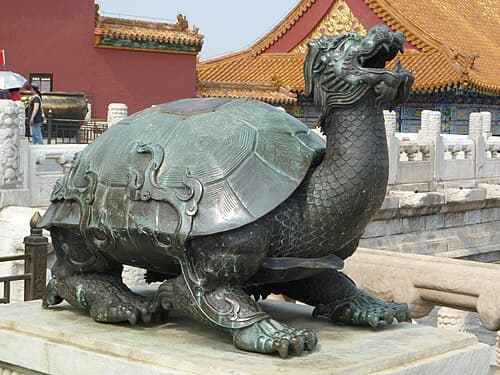
China
The Dragon Turtle combines the protective wisdom of the turtle with the powerful success energy of the dragon, creating one of feng shui's most potent talismans for career advancement.

China
The gold sycee ingot — the boat-shaped gold and silver currency of imperial China — is the most direct and universally recognized symbol of accumulated financial wealth in the Chinese tradition.

