

186
Protection
👁️
Persian Evil Eye (Cheshm Nazar)
Iran
The ancient Persian eye charm — cheshm nazar — protecting against envy with the same blue eye tradition spanning from Iran to Greece.
4.4Learn more →

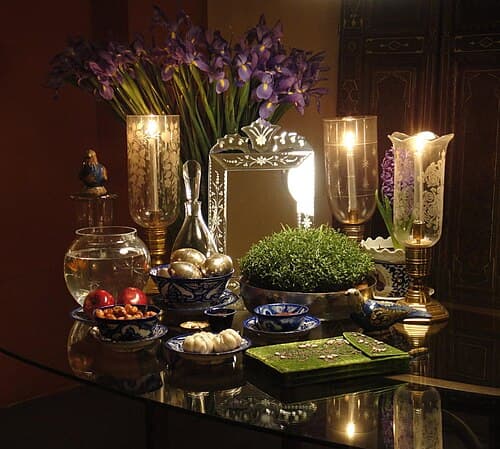
The seven-S Nowruz table — Iran's ancient New Year blessing ritual arranging seven symbolic items to invite spring's full abundance.
The Haft-Sin (هفتسین, seven S's) is the centerpiece of Persian Nowruz (New Year) celebration — a table arranged with seven items whose Persian names begin with the letter 'S' (sin), each symbolizing a specific blessing for the coming year. The traditional items include: sabzeh (sprouted wheat/lentils — rebirth), samanu (wheat pudding — prosperity), senjed (dried lotus — love), seer (garlic — health), seeb (apple — beauty), somaq (sumac — sunrise/patience), and serkeh (vinegar — aging and wisdom). A live goldfish, a mirror, candles, painted eggs, and a copy of sacred text may accompany the seven sinned items.
Nowruz itself is the world's most ancient living celebration — at least 3,000 years old, predating Islam by two millennia. The spring equinox celebration at the moment of the new year (determined astronomically, not by any religious calendar) makes it a celebration of natural renewal that all Iranians share across religious differences. The Haft-Sin table's preparation is a family meditation on blessing — each item placed consciously with its specific intention.
As a lucky charm system, the Haft-Sin represents the most sophisticated luck practice in this collection — not a single object but an intentional ensemble, each element contributing a specific blessing to form a complete picture of abundant human life. A miniature Haft-Sin set carried or displayed year-round invites all seven blessings continuously.
The complete blessing of the new year — rebirth, prosperity, love, health, beauty, patience, and wisdom assembled together in intentional harmony at spring's astronomical moment.
Arrange a full Haft-Sin table at Nowruz (spring equinox) with the seven items, adding a goldfish (vitality), mirror (self-reflection), candles (enlightenment), and painted eggs (fertility). Touch each item while naming its blessing. A miniature symbolic set can be displayed year-round to continuously invite these seven blessings.
Nowruz is celebrated by over 300 million people across Iran, Afghanistan, Azerbaijan, Kazakhstan, Kyrgyzstan, Tajikistan, Turkey, and the Iranian diaspora worldwide — making it one of the world's most globally celebrated holidays. The United Nations officially recognized Nowruz as an international day of celebration in 2010.
Nowruz belongs to all who celebrate spring's return. Non-Iranians are welcomed to Haft-Sin tables throughout the Iranian world. Creating your own table with the seven symbolic items is an act of cultural appreciation that carries genuine blessing regardless of origin.
Sabzeh (the sprouted greens) is most central — the new growth of spring in a dish, representing rebirth. It must be planted weeks in advance, making its preparation itself a meditative act of conscious anticipation.
The sabzeh (sprouted greens) is traditionally thrown into running water on the 13th day (Sizdah Bedar, the nature festival), releasing the winter's accumulated troubles. The goldfish is either kept or released into a pond. Edible items are eaten. The celebration's blessing has been fully activated and distributed.
Iran
The ancient Persian eye charm — cheshm nazar — protecting against envy with the same blue eye tradition spanning from Iran to Greece.

Armenia
Armenia's beloved national fruit — the pomegranate representing fertility, prosperity, and the blessing of 365 seeds for each day of the year.
Azerbaijan
The pomegranate of the Caucasus — Azerbaijan's national symbol representing prosperity, fertility, and the beauty of life's abundance.

