

180
General
🎨
Javanese Batik Symbols
Indonesia
Sacred textile patterns encoded with Javanese cosmology, batik is both high art and living magical script worn on the body.
4.4Learn more →


The sacred wavy-bladed dagger of Java is both a masterwork of metallurgy and a living talisman possessing its own spirit and destiny.
The keris (also spelled kris) is a distinctive asymmetrical dagger from the Indonesian archipelago, specifically from the Javanese tradition, with a blade that typically has a wavy form (the number of waves, called luk, ranges from 3 to 29 and must be odd). Unlike ordinary weapons, a keris is understood to be a living object with its own spiritual essence (tuah) and personality that must be compatible with its owner. Incompatible keris are believed to bring misfortune rather than protection, while a keris whose spiritual nature aligns with its owner can provide extraordinary protection, luck, and power.
The creation of a keris is one of the most spiritually demanding crafts in Indonesian culture. The empu (master smith) who forges a keris must maintain ritual purity throughout the process, observe specific fasting and prayer regimens, and perform the work during astrologically auspicious times. The finest keris contain materials of extraordinary symbolic power, including meteoritic iron (pamor), which is folded with terrestrial iron in a process that can involve thousands of layering cycles. The resulting blade patterns — called pamor motifs — carry specific magical properties and are named and classified in elaborate taxonomies.
In 2005, UNESCO inscribed the Indonesian keris on its Representative List of the Intangible Cultural Heritage of Humanity, recognizing not just the physical object but the entire complex of knowledge, practice, and belief that surrounds it. A keris is held upright and never pointed at people casually; it is stored in a specific orientation depending on its purpose; it is fed offerings of flowers and incense on specific nights; and it is consulted before major decisions. The relationship between a Javanese man and his keris is among the most sophisticated relationships between a human and a sacred object in world spiritual tradition.
Living spiritual protection, the embodiment of power and authority, compatibility between the owner's destiny and the blade's tuah (spiritual essence), and the concentrated skill of sacred metallurgy.
Keep the keris wrapped in cloth when not in use, stored in a dedicated space at home. Offer flowers and incense on Thursday nights (the traditional night for keris care). Never draw the blade in anger or point it casually at others. Have a practitioner determine the keris's pamor and assess its compatibility with your personal energy. Polish the blade annually with a specific solution of lime and arsenic according to tradition.
The wavy blade of a keris is not decorative — the specific number of waves (luk) must always be odd (3, 5, 7, 9... up to 29) because even numbers are considered incomplete and thus spiritually imbalanced. The number of waves is one of the primary factors in determining the keris's spiritual character and appropriate owner.
In Javanese tradition, a dukun (spiritual practitioner) or empu (master smith) can assess compatibility between a person and a specific keris. The assessment involves examining both the person's birth date and spiritual profile and the keris's pamor pattern and spiritual character. Physical sensations when holding the blade — warmth, tingling, or discomfort — are also used as indicators.
Yes. While the keris is associated with male authority in its most formal ceremonial uses, women have always owned and used keris for protection. Female keris tend to be shorter (called keris pendok) and may be kept hidden in clothing. Some of the most powerful keris in Indonesian history were reportedly owned and wielded by female rulers and warriors.
Pamor is the distinctive folded metal pattern visible on the keris blade, created by folding together iron and nickel-rich materials (often meteoritic iron). Different pamor patterns have names and are believed to convey specific powers: Pamor Beras Wutah (spilled rice) brings abundance; Pamor Ngulit Semangka (watermelon skin) brings good health; Pamor Wengkon (border) provides protection. The pamor is the blade's magical identity.
Indonesia
Sacred textile patterns encoded with Javanese cosmology, batik is both high art and living magical script worn on the body.
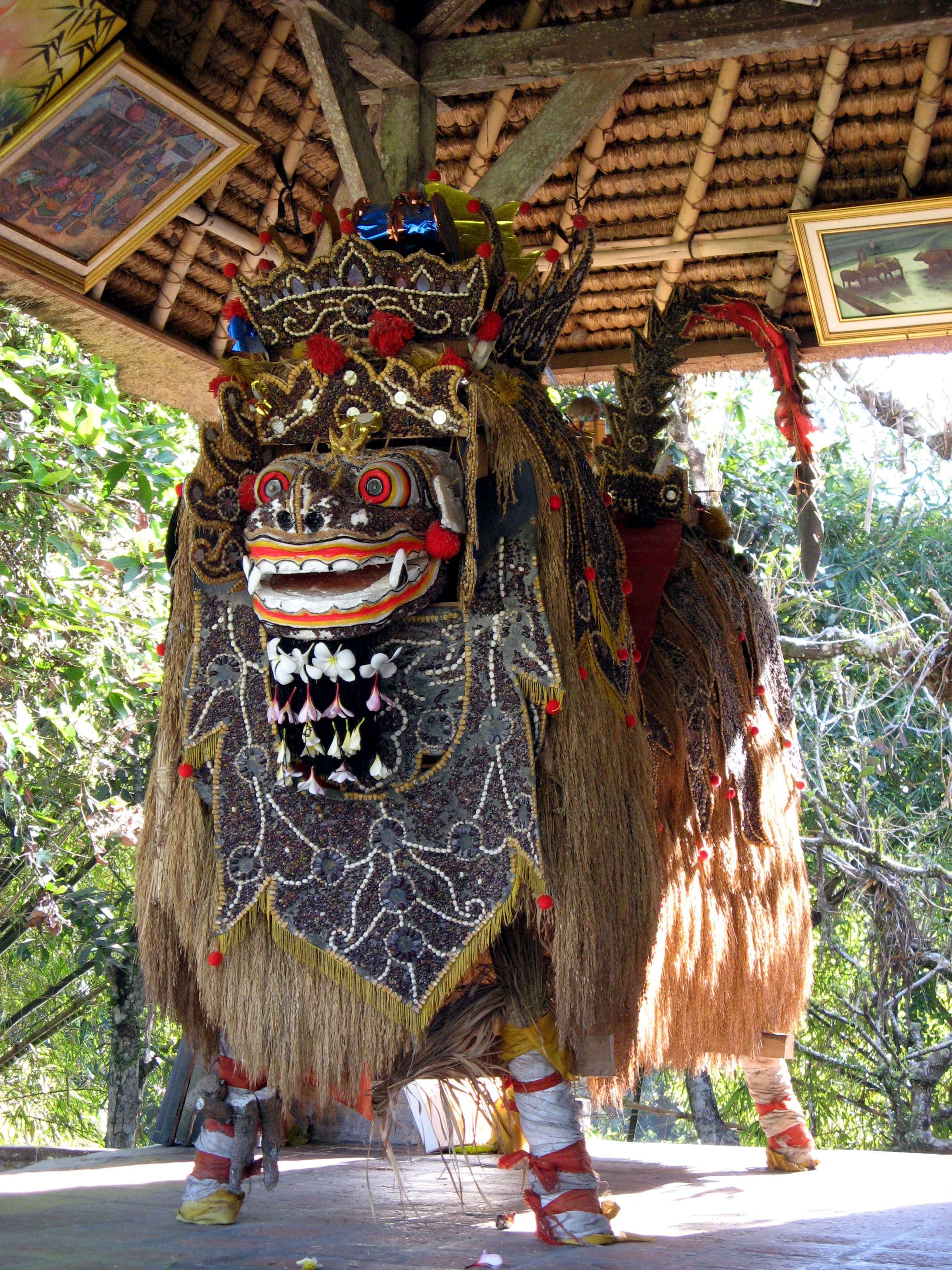
Indonesia
The lion-like protective deity Barong leads a cosmic battle against evil and chaos, represented in Bali's most sacred ritual dance.

Thailand
A sacred phallic amulet from Thailand believed to provide extraordinary luck, sexual power, and protection from harm.
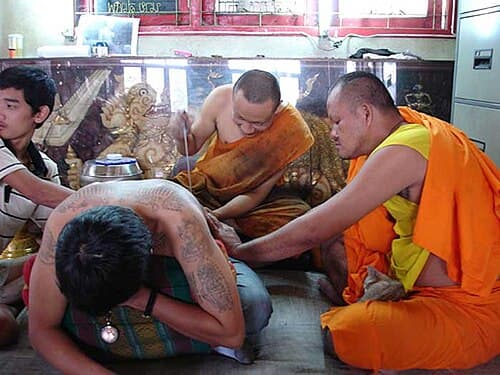
Thailand
Sacred geometric tattoos blessed by monks carry the power of the inscribed formulas directly on the body as permanent living talismans.

