
166
General
🐢
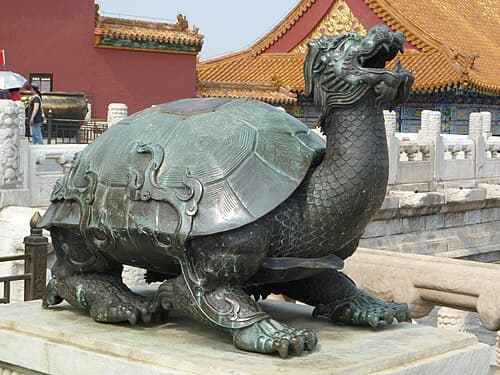
Vietnamese Dragon Turtle
Vietnam
The mythical Long Quy combines the turtle's longevity with the dragon's power, symbolizing wisdom, strength, and enduring fortune.
4.5Learn more →


The multi-headed serpent deity Naga guards Angkor Wat and represents the cosmic bridge between the human and divine worlds.
The Naga is a divine serpent being of enormous importance across South and Southeast Asian cosmology, but nowhere does it hold greater architectural and cultural prominence than in Cambodia, where seven-headed Naga sculptures guard the causeways leading to Angkor Wat and define the aesthetic of Khmer sacred space. In Cambodian tradition, the Naga is the ancestral progenitor of the Khmer people — legend holds that the Khmer nation was born from the marriage of an Indian Brahmin named Kaundinya to the Naga princess Soma, daughter of the Naga king who ruled the sea. The entire Cambodian nation is thus literally descended from the Naga in their founding mythology.
The Naga in Cambodian iconography is typically depicted as a multi-headed cobra with a hood that fans out into multiple heads, the number indicating its power level (one head for ordinary nagas, three, five, seven, and nine heads for increasingly powerful beings). The seven-headed Naga at Angkor is particularly potent — seven represents the seven colors of the rainbow (the Naga creates rainbows when it travels between the earthly and divine realms), the seven days of the week, and the perfect number of divine power. The Naga's scales create water in dry seasons and provide shelter from floods in monsoon — its relationship with water makes it a deity of life itself in the Mekong civilization.
As a personal talisman, Naga imagery on pendants, rings, and arm bands provides water-related protection (essential for seafarers, fishermen, and those who travel near water), guards against snake bites and similar dangers, and connects the wearer to royal and ancestral Khmer identity. The Naga's function as a bridge between realms also makes it an excellent talisman for anyone seeking to communicate across boundaries — between cultures, between social strata, or between the physical and spiritual worlds.
Protection over water, ancestral power, the cosmic bridge between human and divine, rain and fertility, and the primordial energy of the Khmer civilization.
Wear a Naga pendant or arm ring when traveling near water or by sea for protection. Place a Naga image at the entrance of home or business, especially when the property is near water. For Cambodian and Khmer diaspora communities, maintaining a Naga altar is a powerful connection to ancestral blessings. Offer water and lotus flowers to Naga imagery.
The annual Bon Om Touk (Water Festival) in Cambodia, celebrating the reversal of the Tonle Sap River's flow, is fundamentally a Naga festival — the river's extraordinary reversal (it flows north from June to October, then reverses south again) was explained by ancient Khmers as the Naga turning in its annual sleep. The festival draws over a million people to Phnom Penh to honor the Naga of the waters.
They share the same Indian origin mythology — the Naga entered Cambodian culture through Brahmanism in the first centuries CE. However, the Cambodian Naga developed its own cultural specificities over millennia, including the foundation myth of the Khmer people's Naga ancestry, which is not found in Indian traditions. The Cambodian Naga is the Indianinfluence fully localized.
One head indicates a minor serpent spirit. Three heads represent the Hindu trinity (Brahma, Vishnu, Shiva). Five heads govern the five elements. Seven heads — the most commonly depicted — represent the seven tiers of heaven, the rainbow, and perfect divine power. Nine heads are associated with kingship and the highest celestial authority.
This concern exists in some folk traditions, but is not a significant part of mainstream Naga belief. The Naga is a divine being entirely distinct from common snakes, and wearing Naga imagery is more commonly believed to protect against snake bites rather than attract serpents. The divine Naga's relationship with ordinary snakes is analogous to the relationship between a king and common people — sharing a form but not a nature.
Vietnam
The mythical Long Quy combines the turtle's longevity with the dragon's power, symbolizing wisdom, strength, and enduring fortune.

Thailand
A miniature dwelling placed outside Thai homes and businesses to house the property's protective spirit and maintain good relations with the spirit world.

India
Rising pure from muddy water, the lotus is the universal symbol of spiritual awakening and untouched beauty across Asia.

India
The sacred conch shell is blown at auspicious moments to purify the atmosphere and invoke divine blessing across Hindu and Buddhist traditions.

