

106
General
🌀
Triskele
Ireland
The ancient triple spiral of the Celts, encoding the threefold nature of reality.
4.5Learn more →

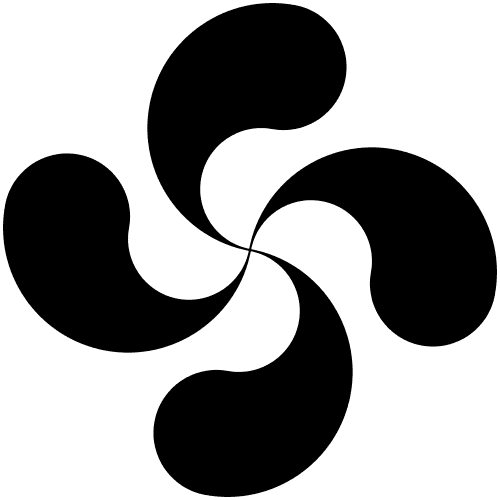
The four-headed Basque cross that spirals through centuries of Iberian sacred tradition.
The lauburu — Basque for 'four heads' — is the distinctive four-armed symbol of the Basque people, a swastika-like design whose arms terminate in comma or hook shapes that give it a dynamic, spinning quality quite different from either the Greek cross or the Nazi misappropriation of the swastika. The lauburu is exclusively Basque, representing a pre-Christian sacred tradition of a people whose language is Europe's greatest linguistic mystery — related to no other known tongue and predating the Indo-European arrivals in Western Europe.
The symbol's exact meaning has been debated by Basque scholars for generations, with interpretations ranging from a representation of the four elements (fire, water, earth, air), to the four seasons, to a solar symbol of cyclical movement, to a representation of the cross of Christ adapted to indigenous Basque sacred forms after Christianisation. The most likely explanation is that like many ancient sacred symbols, the lauburu was multi-layered from the beginning — simultaneously cosmological, solar, and seasonal in its meanings.
The lauburu is found throughout the Basque Country (Euskadi in Spain, Pays Basque in France) on funerary monuments, church facades, folk objects, and modern jewellery. It serves simultaneously as a protective amulet and as an expression of ethnic identity that is particularly meaningful given the Basques' determination to maintain their distinct culture within the larger Spanish and French states. Wearing a lauburu is a cultural statement as much as a luck gesture.
The lauburu represents the dynamic interplay of the four fundamental forces of existence, the perpetual motion of the sacred, and the distinctly Basque understanding that meaning is preserved through form. As a lucky charm it carries the protective power of an extremely ancient tradition and the particular strength of a culture that has maintained its identity against enormous historical pressure.
Wear a lauburu pendant or ring as a protective amulet and a connection to the world's most linguistically ancient European culture. The symbol is particularly meaningful for people of Basque descent as an expression of heritage. Place a lauburu symbol at the entrance of your home for protection. In Basque tradition, the lauburu on a gravestone is a statement that the deceased is protected through all four phases of existence: birth, life, death, and continuation.
The Basque language (Euskara) has no known relatives anywhere in the world — it is a language isolate, the sole survivor of whatever family of languages was spoken in Western Europe before the Indo-European migrations. The lauburu, as a symbol of the Basque people, is thus a connection to Europe's deepest pre-history, predating almost every other symbol in this collection.
They are visually similar but historically and culturally entirely unrelated. The lauburu is specifically Basque and predates the swastika's misappropriation by centuries. It curves differently (the lauburu's arms curve in a comma shape rather than at right angles) and carries exclusively Basque cultural meaning. The visual similarity is one that the Basques find unfortunate and one they consistently clarify.
Yes — the Basque Country straddles the French-Spanish border, and the lauburu is equally significant on both sides. The French Basque region (Pays Basque) uses the lauburu as extensively as Spanish Euskadi. The symbol transcends the national boundary that divides the Basque lands.
Authentic lauburu jewellery is made throughout the Basque Country — in Bilbao, San Sebastián, Biarritz, and Bayonne. Many Basque artisans specialise specifically in lauburu pieces. Online Basque craft shops also carry authentic pieces. The symbol is so regionally specific that it is rarely made outside the Basque area by non-Basque artisans.
Ireland
The ancient triple spiral of the Celts, encoding the threefold nature of reality.

Spain
The proud bull of Spain, emblem of strength, passion, and the courage to face life head-on.

Spain
The blue glass eye that Spain adopted from the Mediterranean to ward off envy.

